-
Title
-
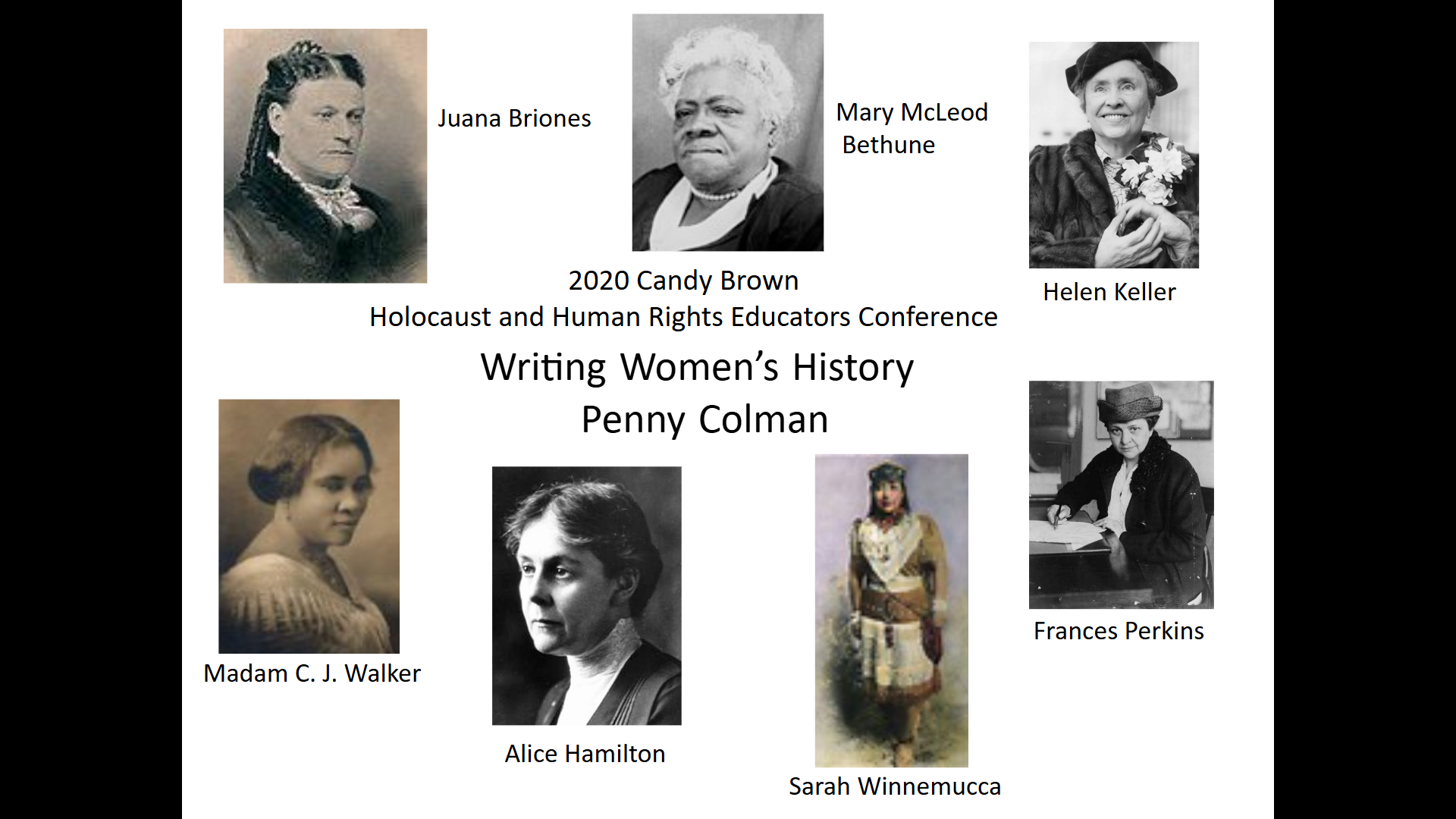
Writing Women’s History
2020 Candy Brown Holocaust and Human Rights Educators Conference
-
Creator
-
Colman, Penny
-
Date Presented
-
2020-07-28
-
Description
-
Penny Colman begins by establishing a personal connection with her audience through her geographic background in New Jersey and the Western United States, as well as her visits to historical sites like the former Women's Museum in Dallas. She explains her primary motivation for researching and writing about women: despite studying history through graduate school, she was rarely taught about the contributions, achievements, or everyday lives of women, whether famous or ordinary.
To trace the evolution of women's historical documentation, the speaker highlights various early primary sources and foundational texts. These range from personal letters and embroidered samplers to major written works, such as Lydia Maria Child's The History of the Condition of Women in Various Ages and Nations and The Narrative of Sojourner Truth (1850). The latter documents Truth's 1826 escape from slavery, her landmark 1828 legal win to regain her son, and her legacy as a prominent abolitionist and women's rights advocate. Additional early sources include Sarah Josepha Hale's Woman's Record (1855), Frank Moore's Women of the War (1867), and reflections from Louisa May Alcott on gender and identity. The speaker also examines the work of Alice Morse Earle, a prolific late-19th-century historian who documented colonial American domestic life, social customs, and the broader economic impacts of trade and slavery.
Finally, the talk addresses the shift from traditional academic history, which historically focused almost exclusively on male leaders, politics, and wars, to modern women's history. Colman describes how the women's rights movement of the 1960s and 1970s spurred the creation of dedicated archives, such as the Schlesinger Library, and inspired pioneering historians to uncover previously marginalized narratives. Groundbreaking works on women's and Black women's history, such as those by Paula J. Giddings and Darlene Clark Hine, helped reshape the field. The presentation concludes with a practical framework for writing women's history, emphasizing the need to critically assess sources, re-frame traditional historical timelines, incorporate intersectionality, and maintain a thoughtful balance between acknowledging systemic oppression and highlighting female agency.
-
Text
-
Delighted to be here today, virtually that is. Just to make a geographic connection: I'm speaking to you from Englewood, NJ, a town across the Hudson River from NYC, where I have lived for many years. But I do have western roots, having been born in Denver, Colorado, lived in Oklahoma City for five years, traveled to and through Texas and given speeches in Houston, San Antonio, and visited the Women's Museum: An Institute for the Future located inside Fair Park, before it closed in 2011 due to lack of funds. Photographed historic women's landmarks in Austin, Hereford,
PP: Quiz
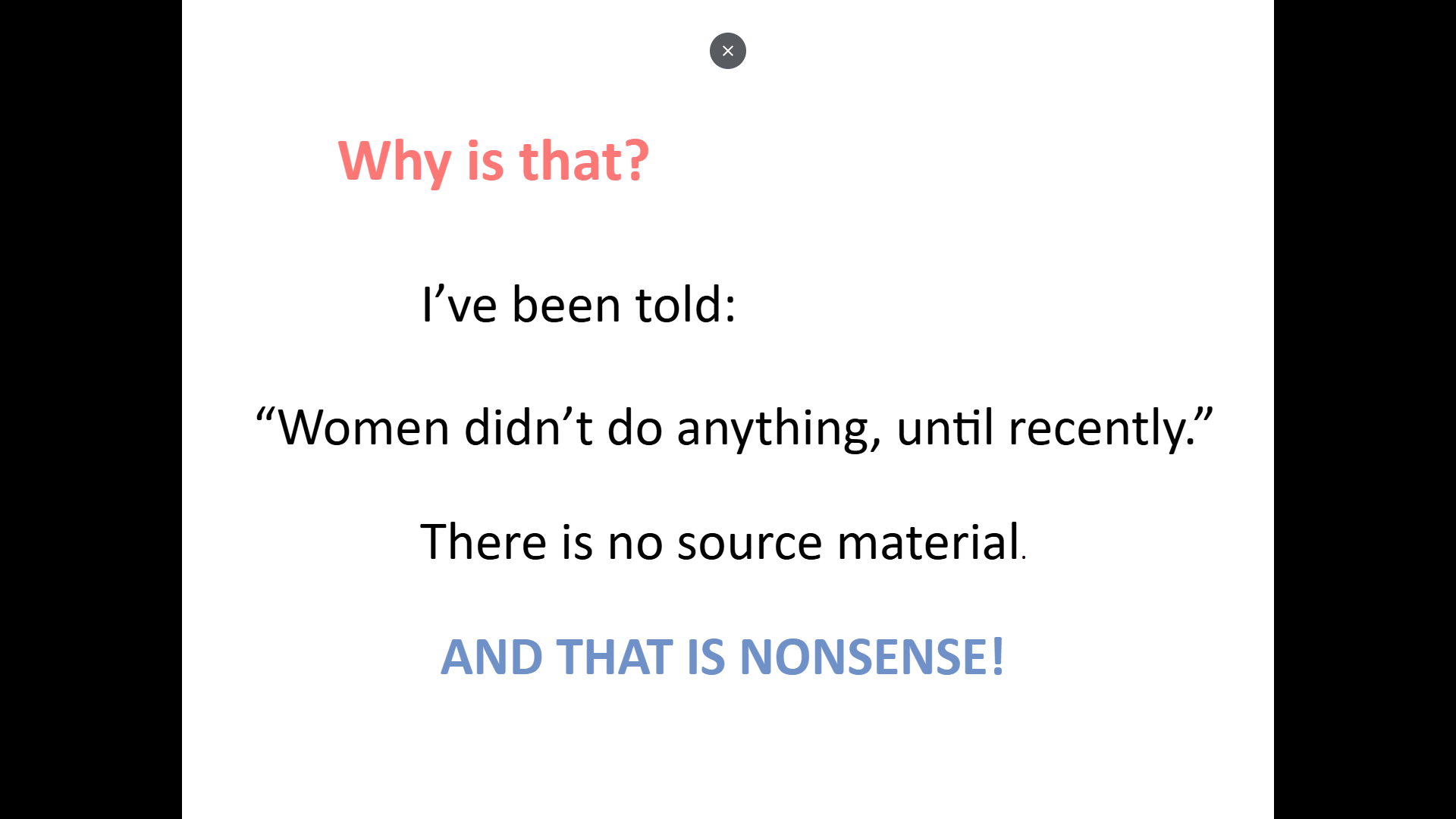
I was inspired to write about women when I realized that despite my years of education-I was a history major in college and graduate school-I NEVER learned much, if anything at all, about women, awesome or ordinary, famous or not famous!
PP: Why is That? CLICK, CLICK, CLICK, CLICK, CLICK BRIEF HISTORY RE WOMEN'S HISTORY
Many sources:
Many documents, e.g. AA's letters, material objects such as samplers
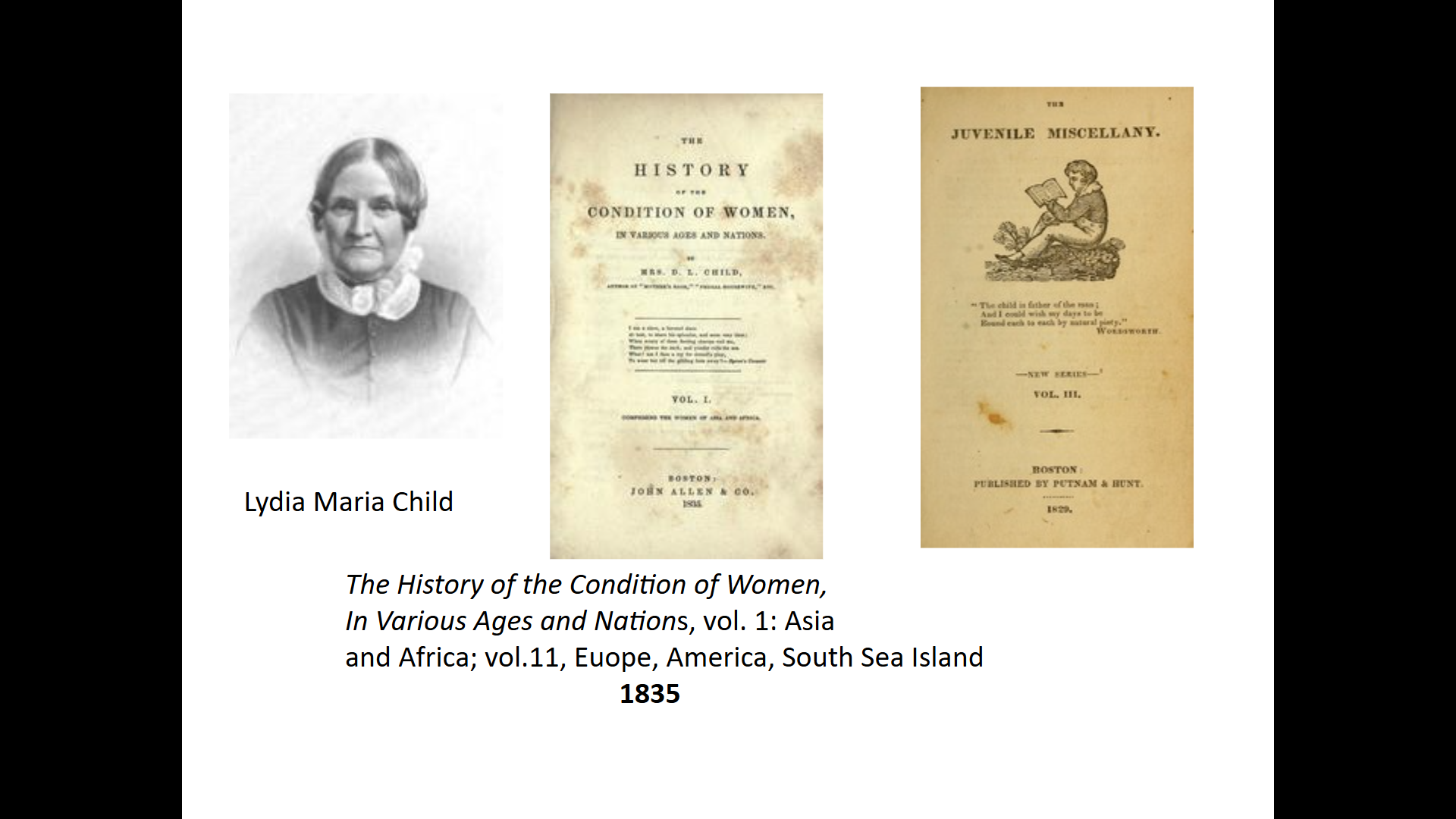
Lydia Maria Child The History of the Condition of Women in Various
Ages and Nations
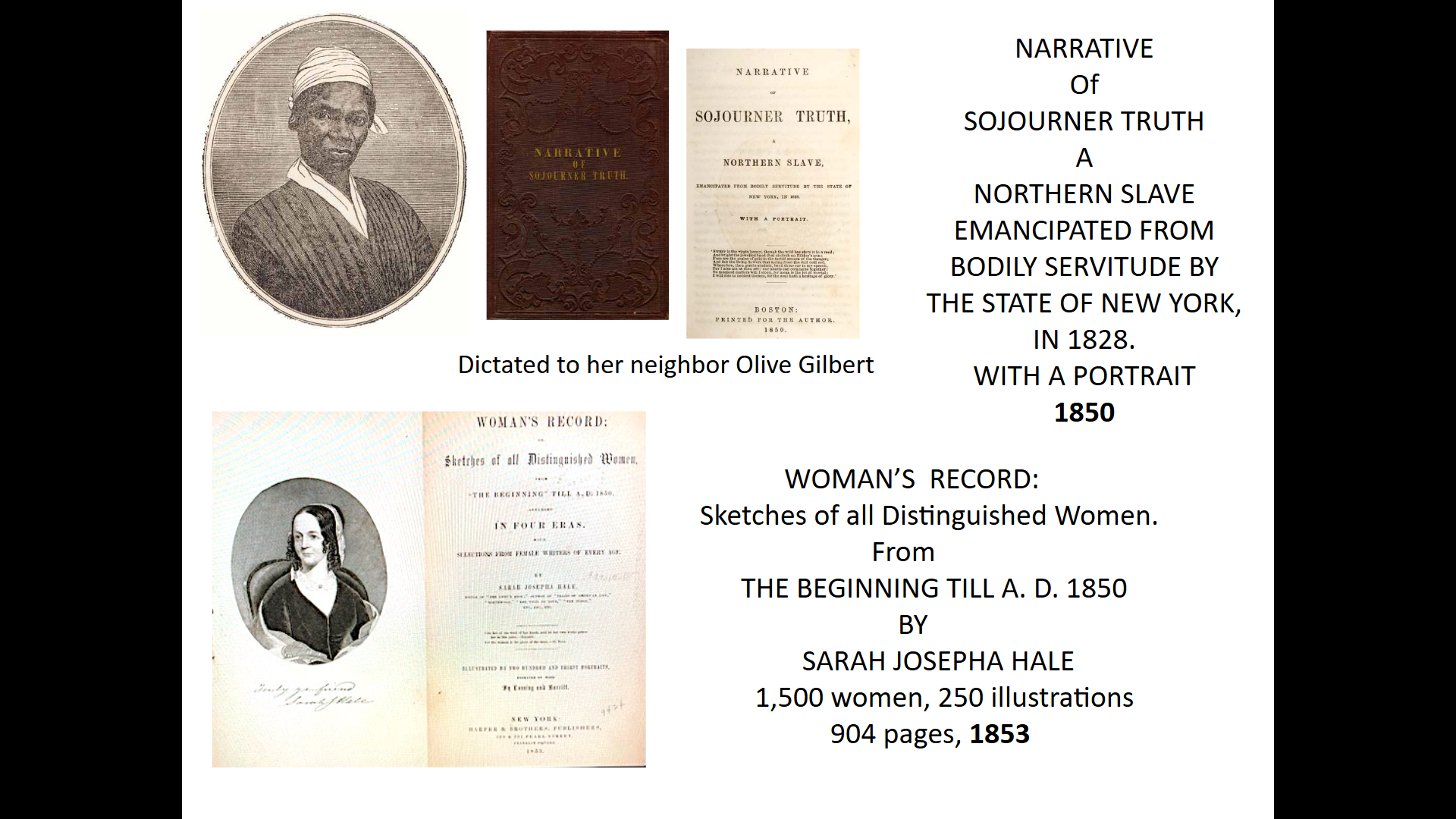
The Narrative of Sojourner Truth, dictated by ST, written and edited by to her friend Olive Gilbert, first published privately in 1850
Dictated to her friend Olive Gilbert and first published privately in 1850, "The Narrative of Sojourner Truth" is the memoir of Sojourner Truth, an African American woman who struggled against the bondages of slavery in the early 1800s. Sojourner Truth was born into slavery around 1797 but escaped with her infant daughter in 1826, finding refuge in the home of Isaac and Maria Van Wagenen of New Paltz, New York. Subsequently in 1828 she would become the first black woman to win a case against a white man when she sued to recover her son, who was still enslaved. Born Isabella Bomefree, Sojourner changed her name to signify her belief that God had tasked her with the mission to go forth and preach the message of abolition. With the strength of her spirituality, Sojourner Truth would overcome many struggles in her life and go on to become a leading abolitionist and champion of women's rights. One of the most famous slave narratives of all time, "The Narrative of Sojourner Truth" is an important historical document of slavery in the United States during [the] first half of the 19th century. This edition includes a biographical afterword [afterward].
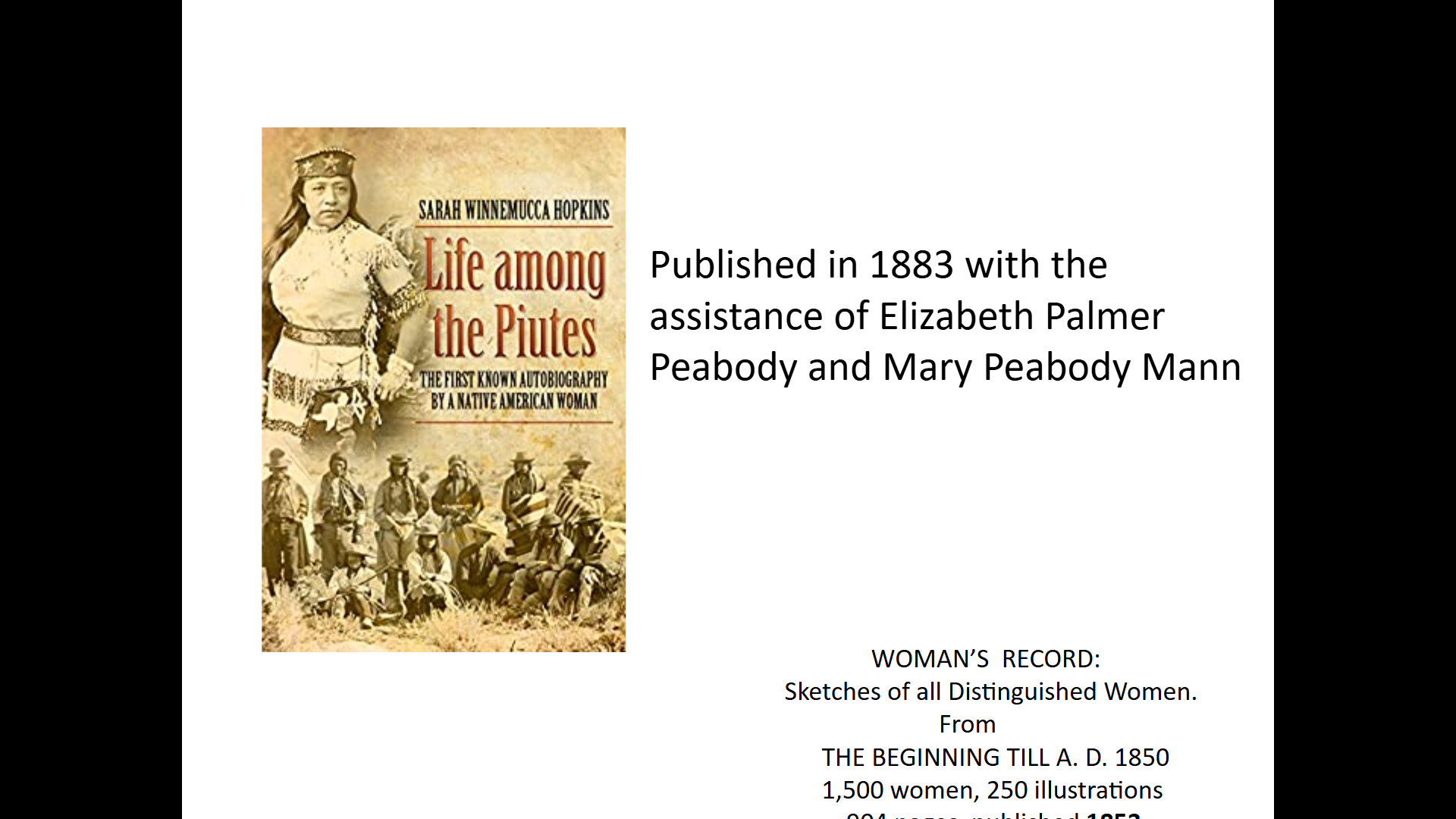
Woman's Record: or Sketches of All Distinguished Women, from Creation to A.D. 1854 Sarah Josepha Hale Harper & Bros. 1855
PC NOTE: foreshadows divergence among women, e.g. SJH's critique of Lucretia Mott
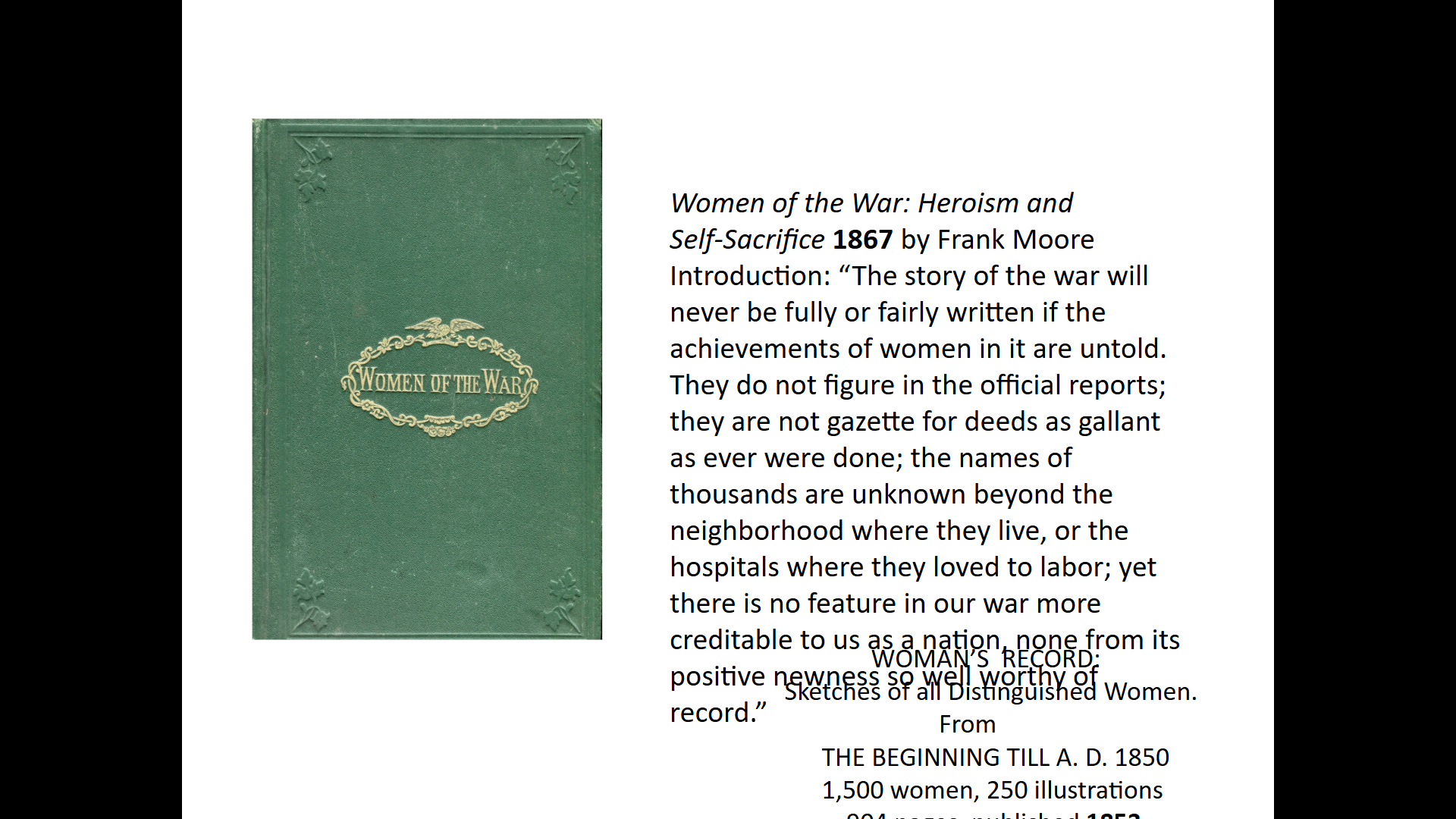
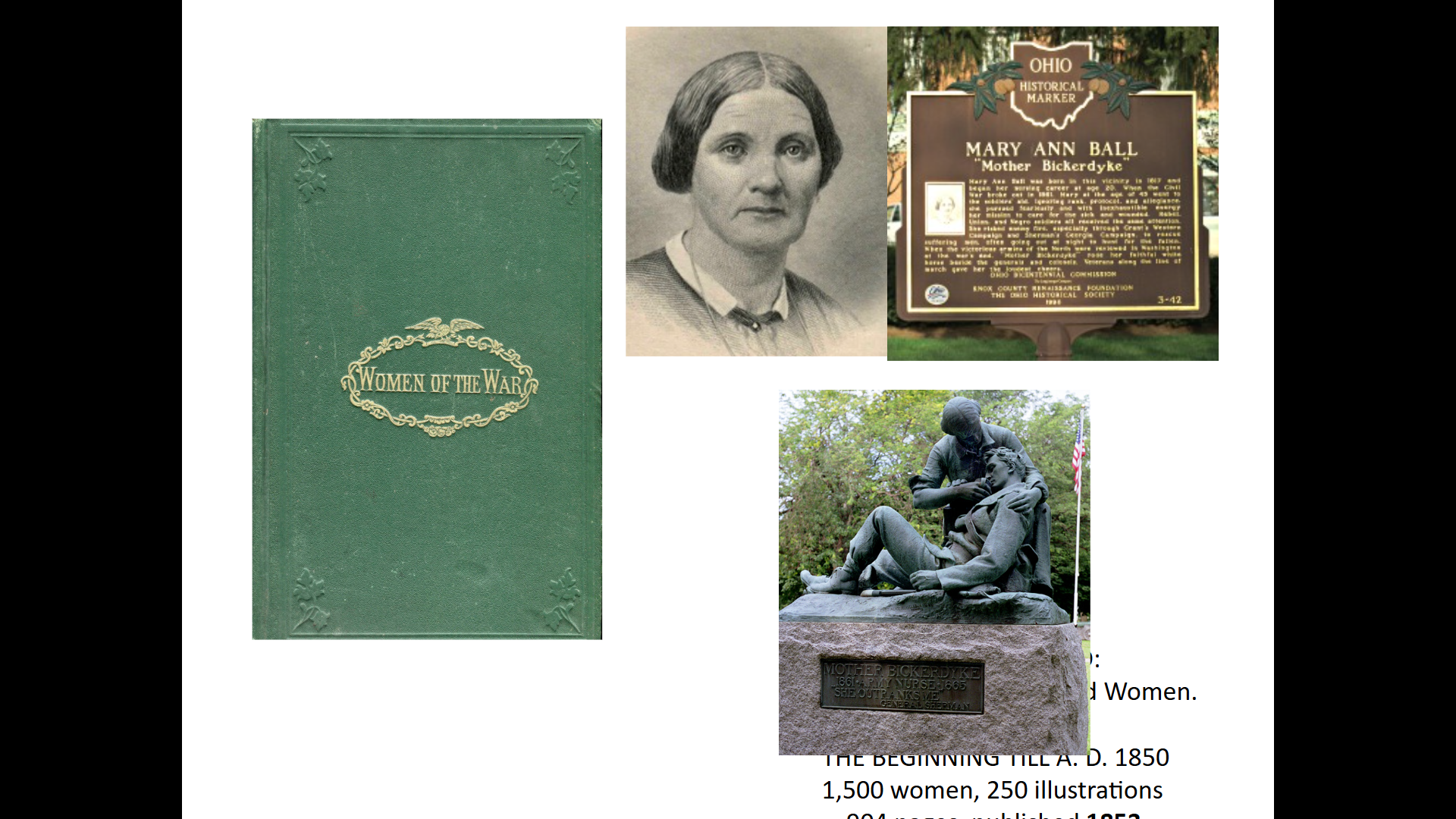
Women of the War: Heroism and Self-Sacrifice 1867 Frank Moore
Introduction: "The story of the war will never be fully or fairly written in [if] the achievements of women in it are untold. They do not figure in the official reports; they are not gazette for deeds as gallant as ever were done; the names of thousands are unknown beyond the neighborhood where they live, or the hospitals where they loved to labor; yet there is no feature in our war more creditable to us as a nation, none from its positive newness so well worthy of record.
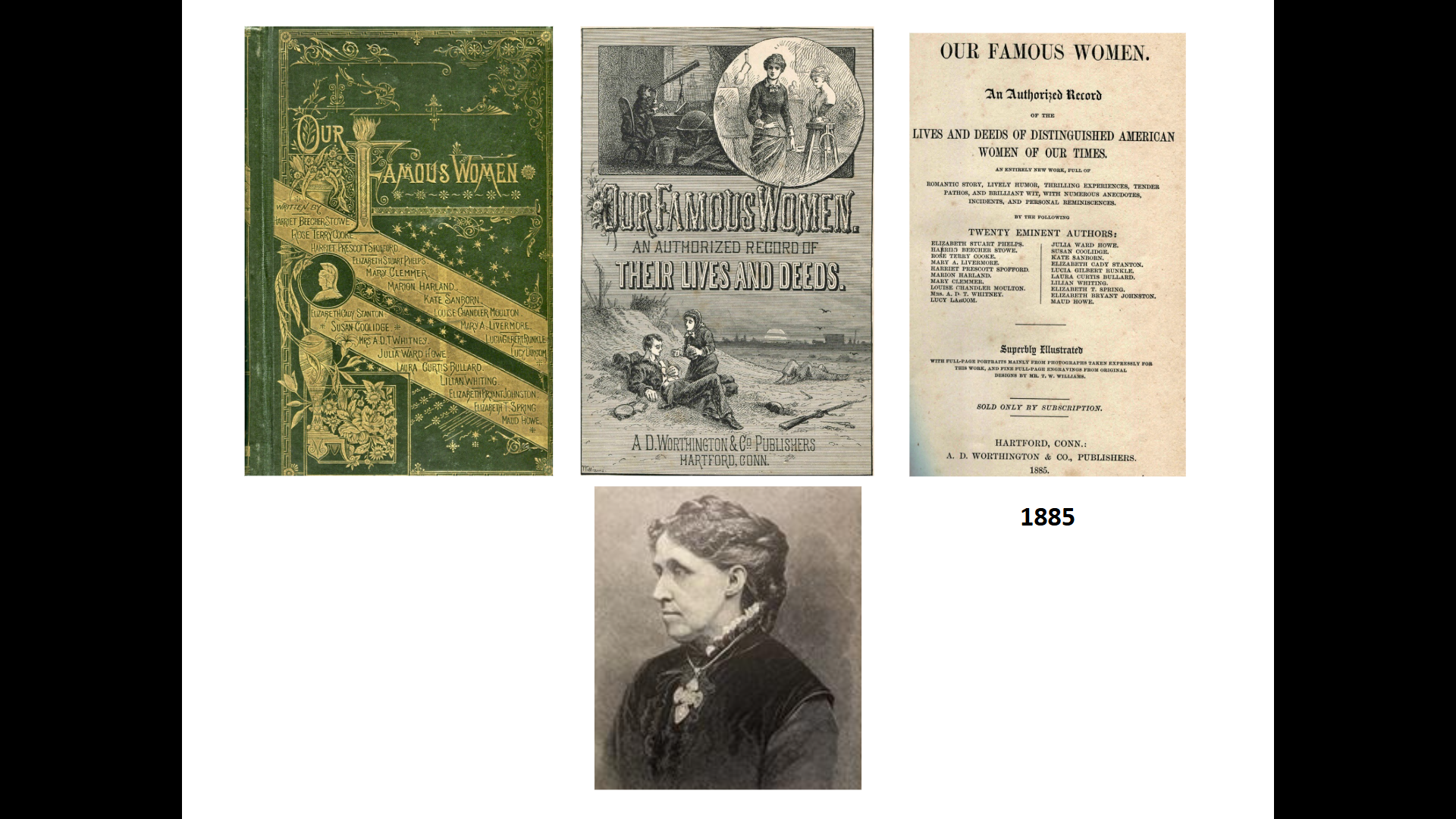
Our Famous Women 1885 A.D> Worthington & Co Publishers Preface
Louise Chandler Moulton: "Miss Alcott certainly carries the burden of her fifty years lightly. If you met her now, you would see a stately lady, unusually tall, with thick, dark hair, clear-seeing, blue-gray eyes, and strong, resolute features, full of varied expressions.
How well I remember the humorous twinkle in her eyes, which half belief [believed] the grave earnestness of her manner, when she told me once that she was inclined to believe in the transmigration of souls.
"I have often thought," she said, "that I may have been a horse before I was Louisa Alcott. As a long-limbed child I had all a horse's delight in racing through the fields, and tossing my head to sniff the morning air.
Now, I am more than half-persuaded that I am a man's soul, put by some freak of nature into a woman's body."
"Why do you think that?" I asked, in the spirit of Boswell addressing Dr. Johnson.
"Well, for one thing," and the blue-gray eyes sparkled with laughter, "because I have fallen in love in my life with so many pretty girls, and never once the least little bit with any man."
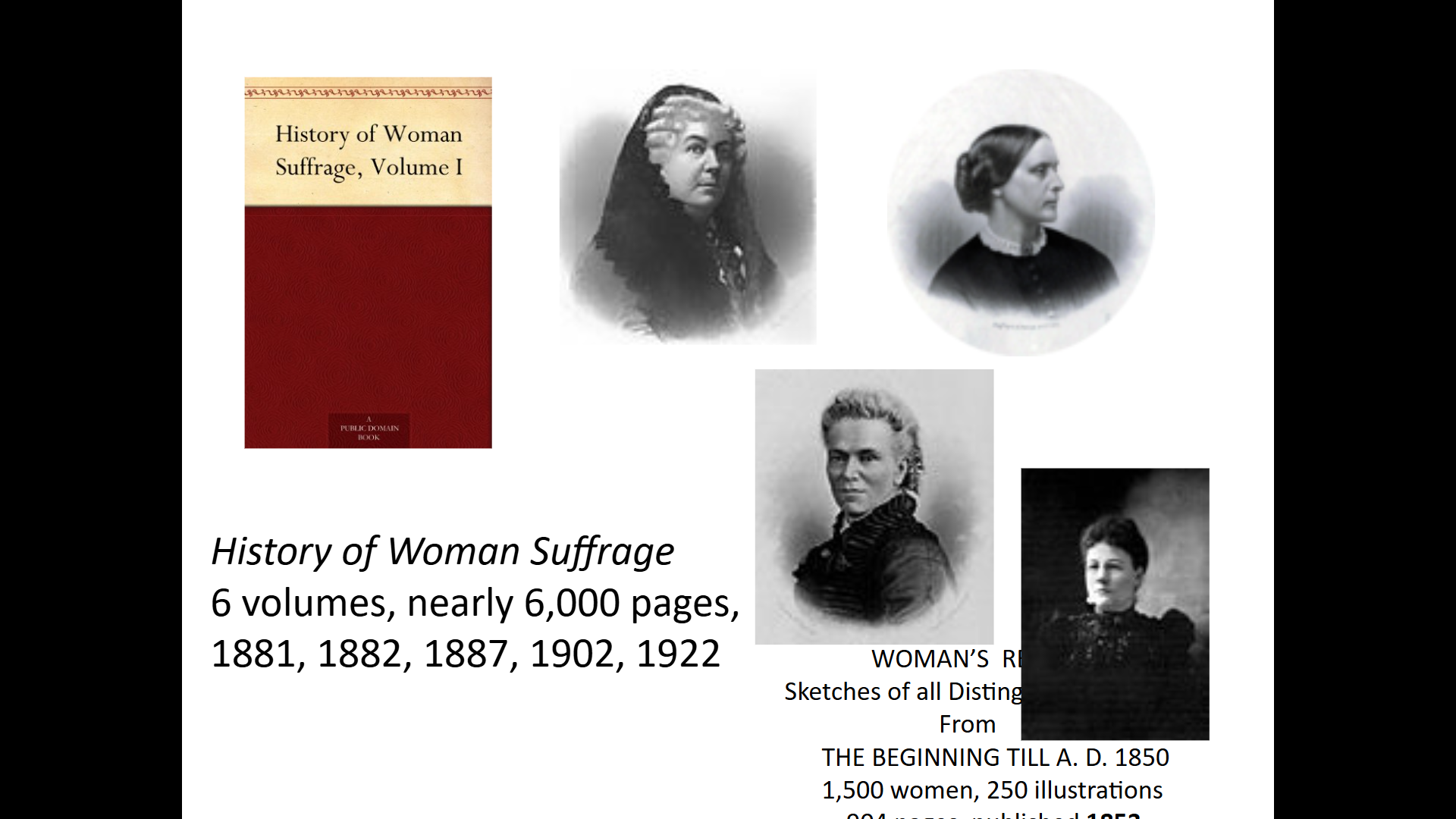
History of Woman Suffrage
Suffragist Historically Reverent
Maud Wood Park donated material "Women's Rights Collection" now the Arthur and Elizabeth Schlesinger on the History of Women in America, Harvard
Artstor Digital Library
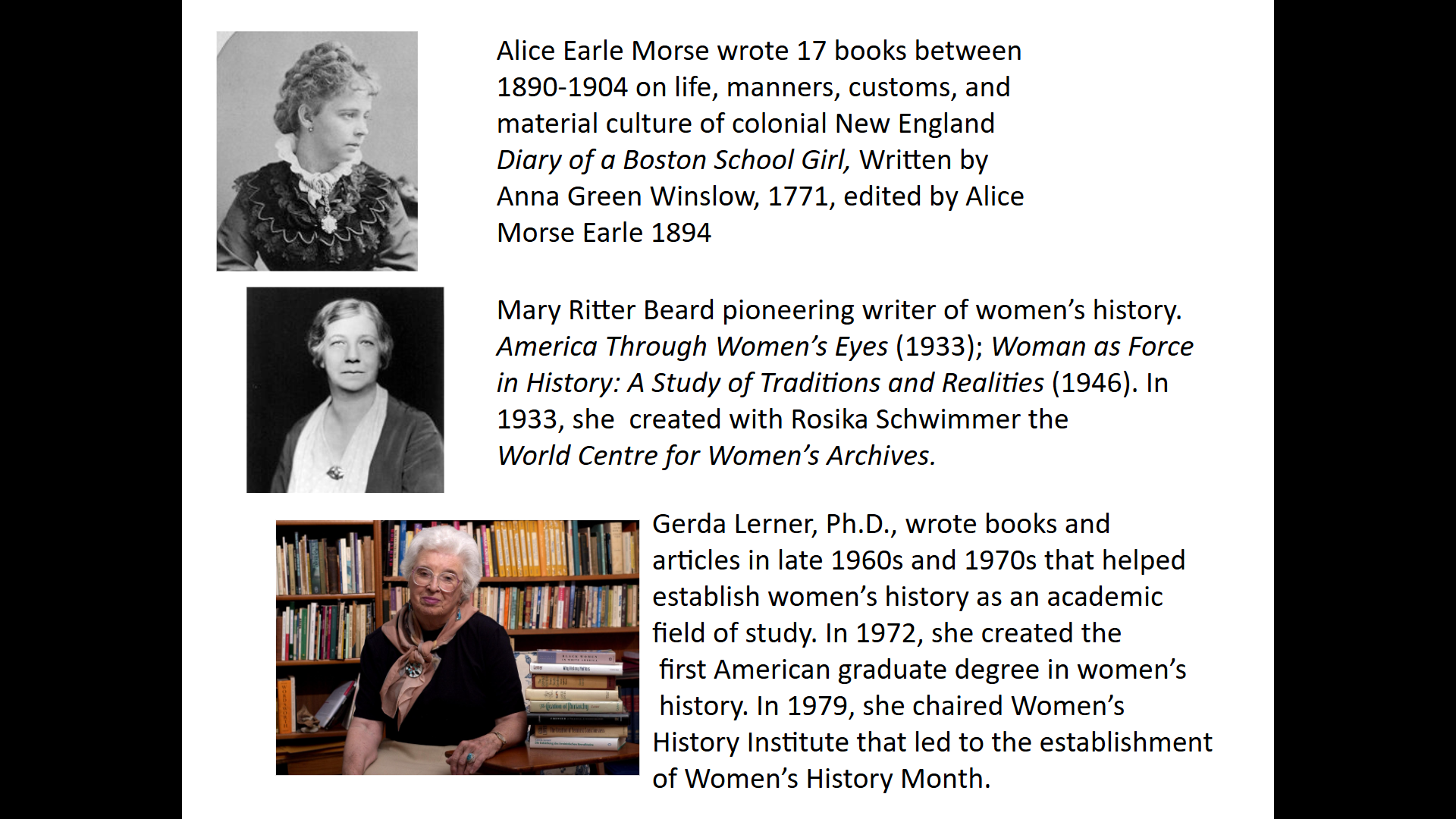
Alice Morse Earle began writing 1890, [in] small sociological detail- Author, collector, and historian Alice Morse Earle (1851-1911) was among the most important and prolific writers of her day. Between 1890 and 1904, she produced seventeen books as well as numerous articles, pamphlets, and speeches about the life, manners, customs, and material culture of colonial New England. Earle's work coincided with a surge of interest in early American history, genealogy, and antique collecting, and more than a century after the publication of her first book, her contributions still resonate with readers interested in the nation's colonial past. An intensely private woman, Earle lived in Brooklyn, New York, with her husband and four children and conducted much of her research either by mail or at the newly established Long Island Historical Society. She began writing on the eve of her fortieth birthday, and the impressive body of scholarship she generated over the next fifteen years stimulated new interest in early American social customs, domestic routines, foodways, clothing, and childrearing patterns. Written in a style calculated to appeal to a wide readership, Earle's richly illustrated books recorded the intimate details of what she described as colonial "home life." These works reflected her belief that women had played a key historical role, helping to nurture communities by constructing households that both served and shaped their families. It was a vision that spoke eloquently to her contemporaries, who were busily creating exhibitions of early American life in museums, staging historical pageants and other forms of patriotic celebration, and furnishing their own domestic interiors.
I used her Diary of Anna Green Winslow: A Boston School Girl of 1771 (1894) Home Life in Colonial Days 1893 Colonial Dames and Good Wives Child Life in Colonial Days (1899)
Does deal with slavery: describes "The making of rum aided and almost supported the slave-trade in this country.... The circle of molasses, rum, and slaves was complete. Many slaves were also landed in New England, but there was no crop there that needed negroes to raise. So slavery never was as common in NE as is the South, where the tropical tobacco and rice fields needed negro labor. But NE's share in promoting negro slavery in America was just as great as was Virginia's.
RE TEA: Many queer mistakes were made through ignorance of its proper use. Many colonists put the tea into water, boiled it for a time, threw the liquid away, and ate the tea-leaves. In Salem they did not find the leaves very attractive, so they put butter and salt on them.
In 1670 a Boston woman was licensed to sell coffee and chocolate, and soon coffee-houses were established there. Some did not know how to cook coffee any more than tea, but boiled the whole coffee-beans in water, ate them, and drank the liquid; and naturally this was not very good either to eat or drink
Academic History-
in thrall of male historians and male-centered history: Founding Fathers, Presidents, great men in general, economics, battles and wars, business, money, sport
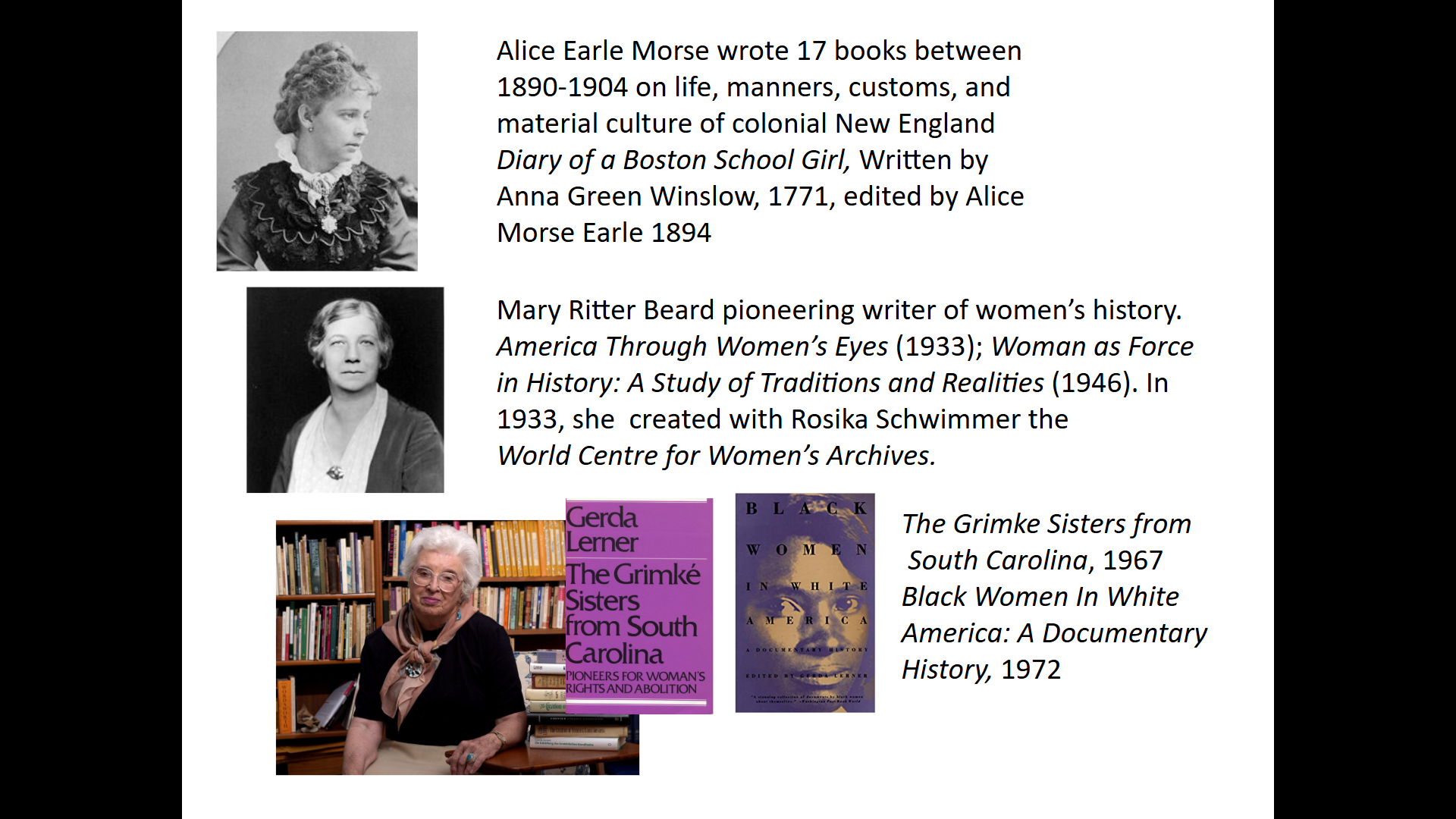
Mary Ritter Beard established World Center for Women's Archives in NYC, 1935, closed 1940 sparked others
e.g. Maud Wood Park Radcliffe where now Arthur and Elizabeth Schlesinger Library, History of Women in America
1960s few female historians, mostly at women's colleges, few graduate students, never more than 10% Alice Kessler Harris a grad student remembered that "It seemed merely natural that we women would choose the kinds of topics that our male colleague chose."
[The] emergence of [the] women's movement in the 1970s resonated and women began to ask Where are the Women?
Rediscovered work of earlier historians: Mary Beard, Eleanor Flexner, Anne Scott and there was Gerda Lerner, activist, organizer, Ph.D.
Columbia bio Grimke sisters that bec [became] a popular textbook... formed Coordinating Committee of Women in the Historical Profession-advocate officers, papers, comm-started journals-though and wrote about styles of learning and teaching infused with feminist, nonhierarchical principles-we knew by the 1902 that we had to use our training to expand our knowledge of our own past and to bring that knowledge to public attention.
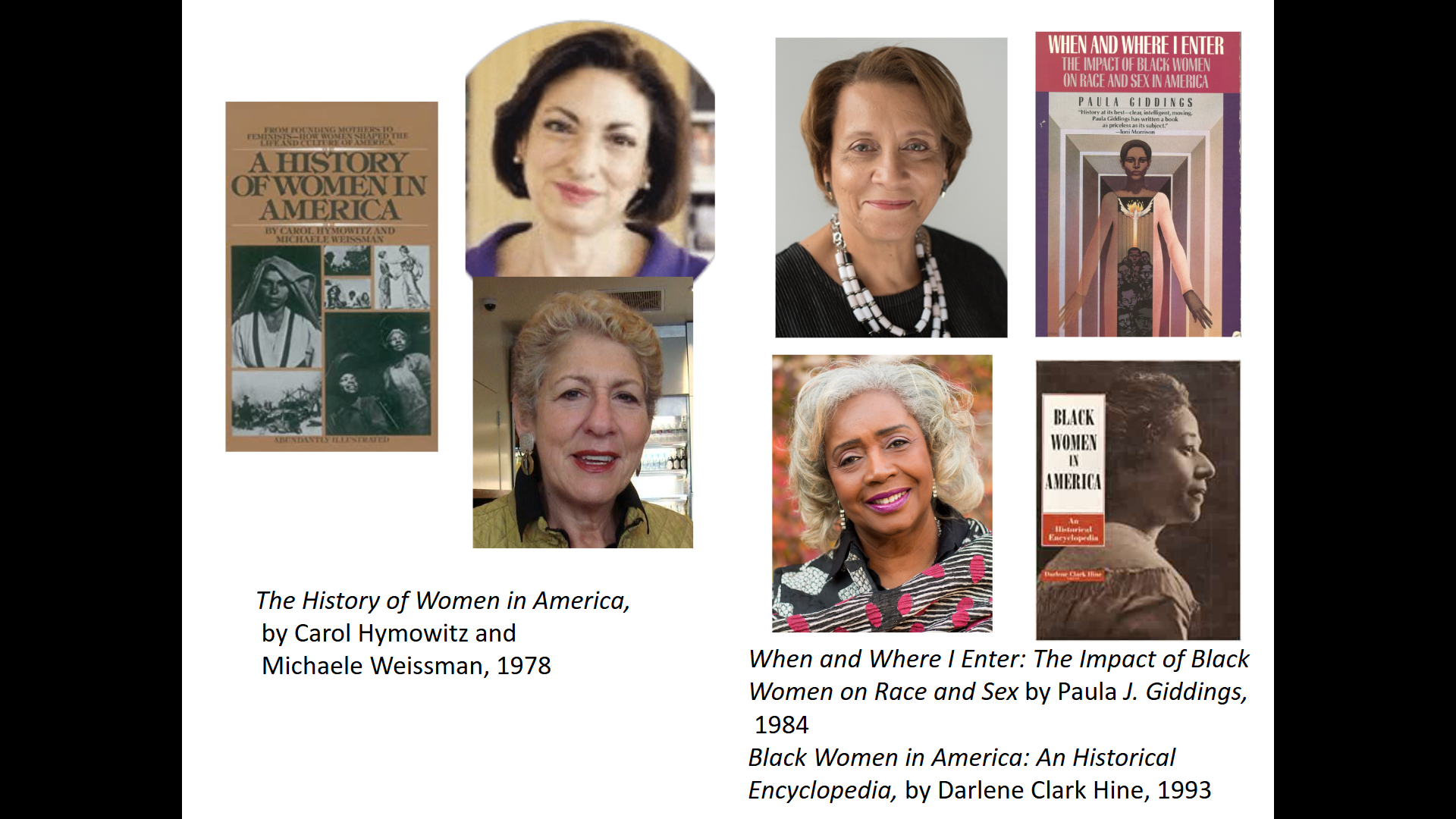
A History of Women in America Carol Hymowitz and Michaele Weissman When and Where I enter: The Impact of Black Women on Race and Sex by Paula J. Giddings
Black Women in America: An Historical Encyclopedia Darlene Clark Hine
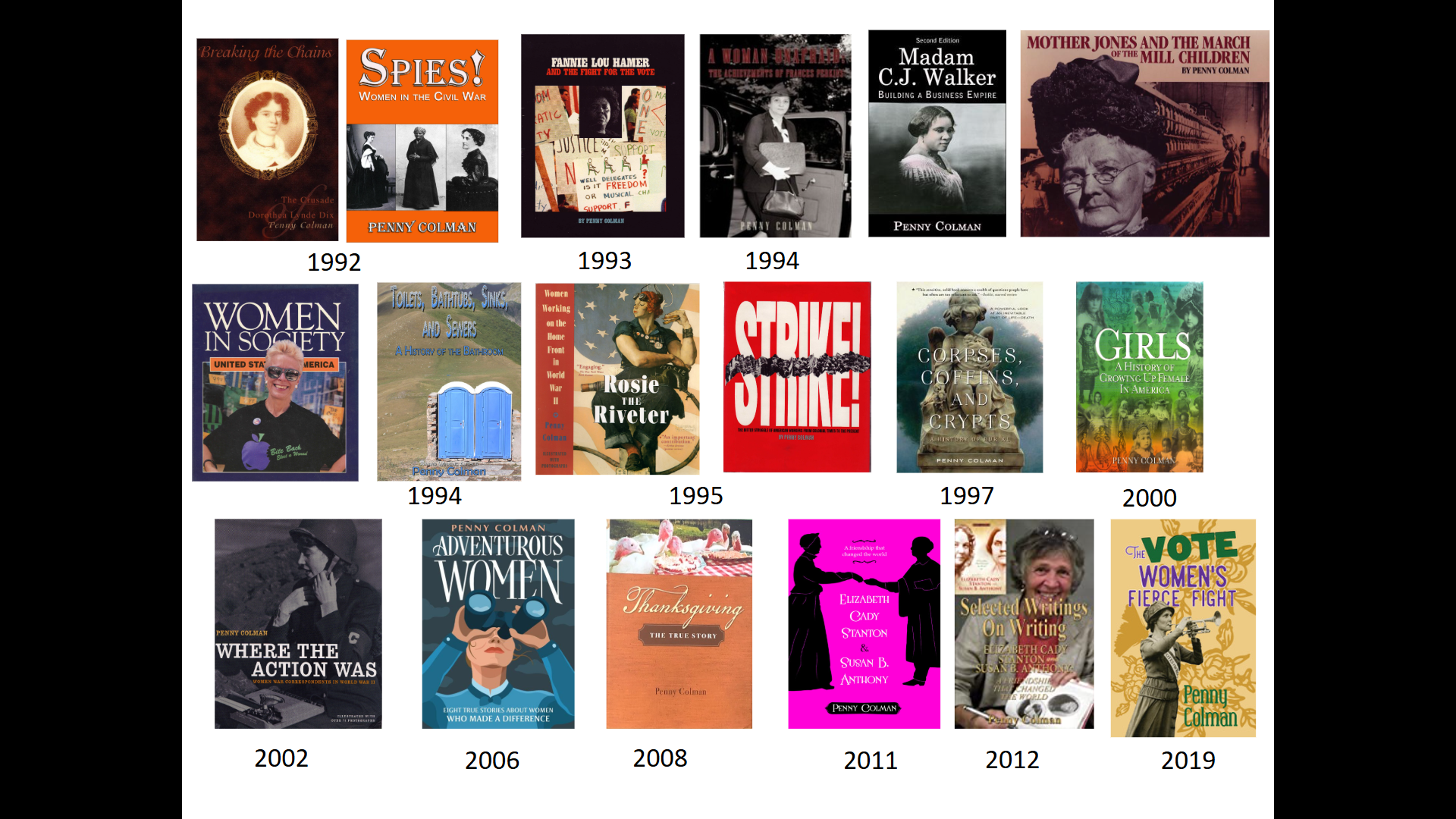
PC'S BOOKS
*Background info
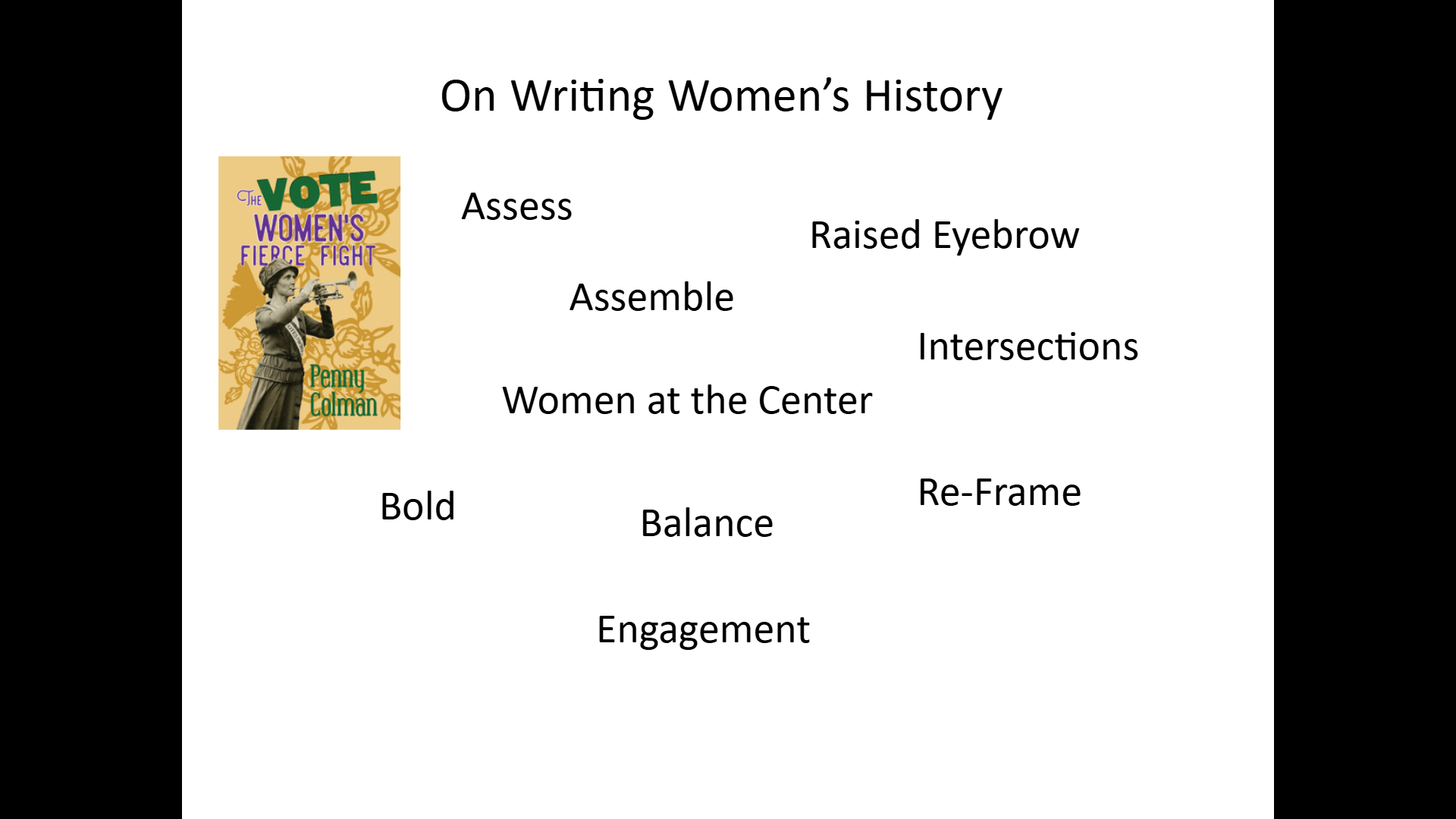
ON WRITING WOMEN'S HISTORY
Use The Vote as an example: Assess ALWAYS with a Raised Eyebrow
Assemble-constant process, tricky now because overwhelming also miss
hands-on e.g. DLD hair, Madam's passport application
Re-Frame, e.g. periodization AND Intersections
Balance, e.g. oppression & agency and Bold e.g. racism & white supremacy
Engagement i.e. with reader
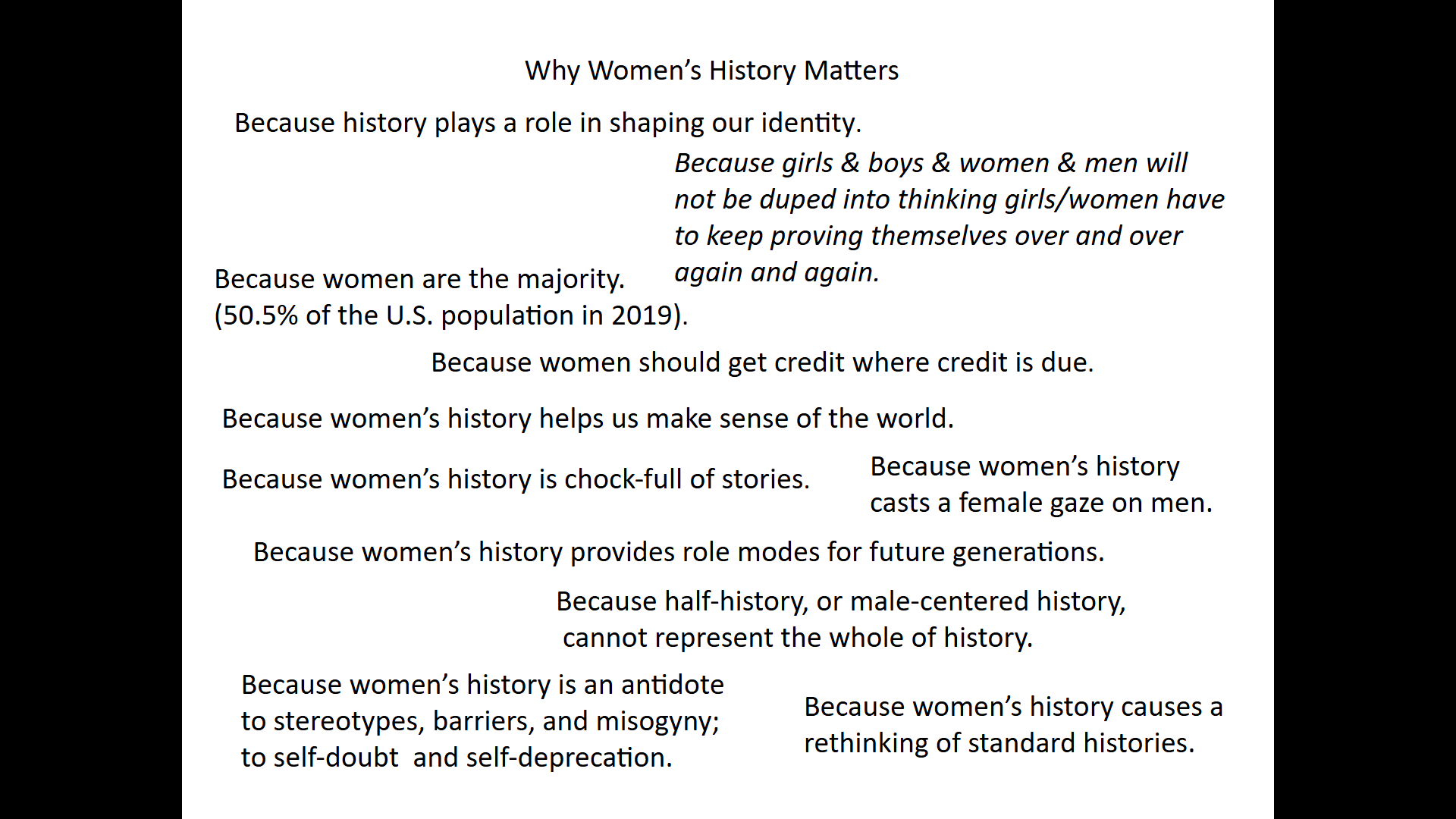
WHY WOMEN'S HISTORY MATTERS
-
Audience
-
Candy Brown Holocaust and Human Rights Educators Conference Attendees
-
Rights
-
CC BY
-
Date Created
-
2020-07
-
Contributor
-
Webb, Matthew