-
Title
-
Sacajawea, Cemetery Sign, Grave and Plaque
-
Biographical Text
-
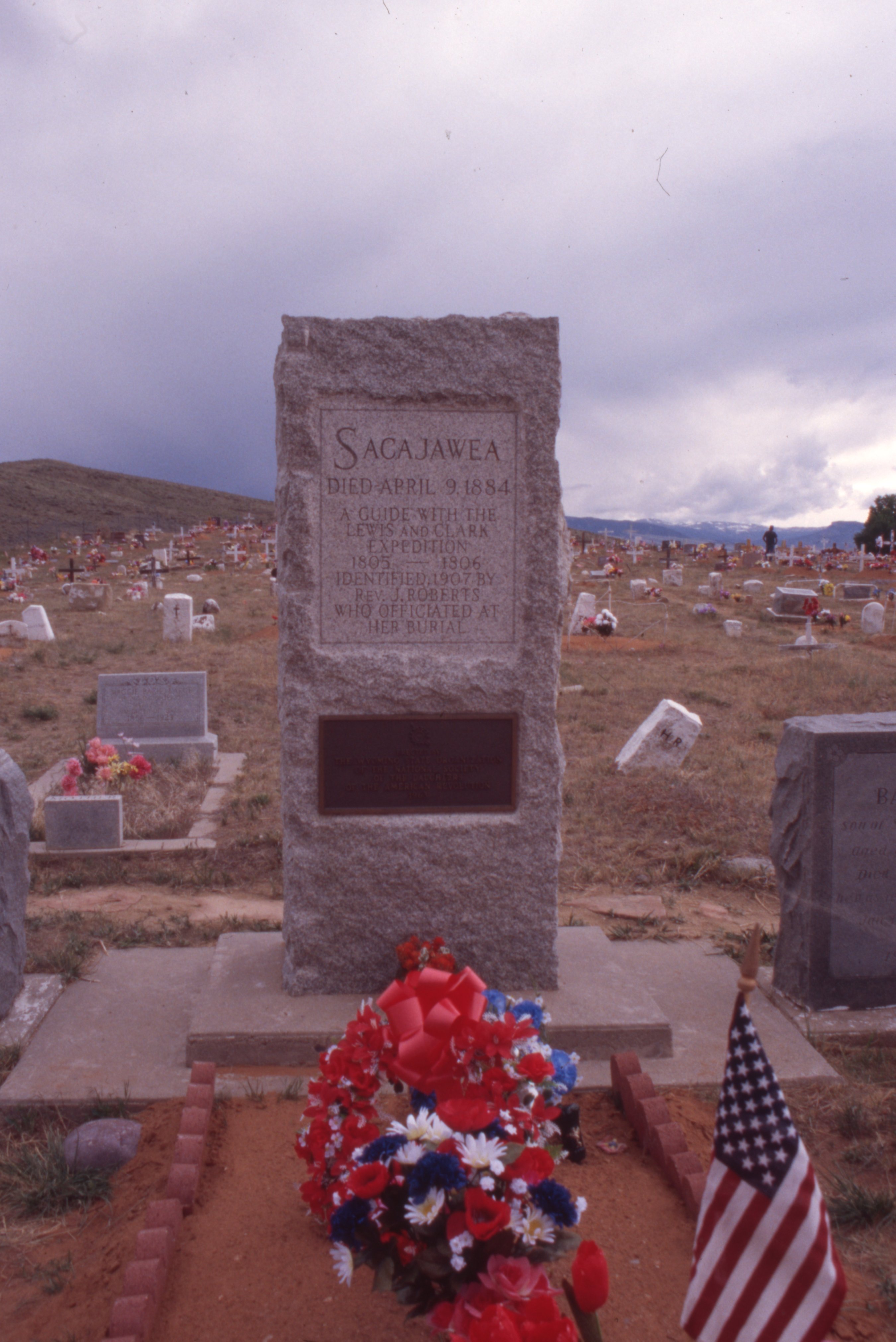
Granite upright gravestone with carved text marking the burial of Sacajawea. Bronze rectangular plaque embedded toward the bottom of gravestone featuring embossed text and circular emblem.
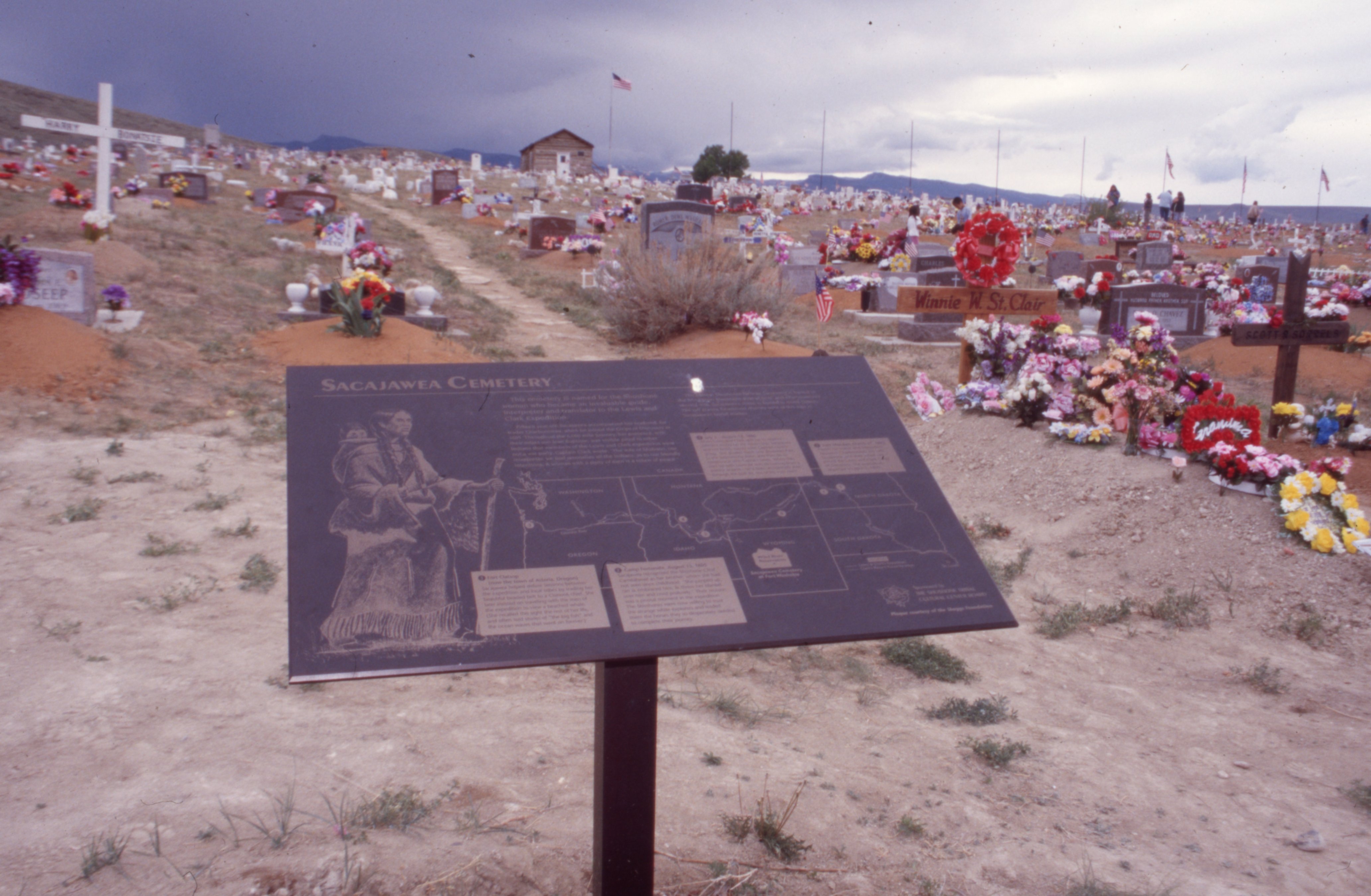
Aluminum square plaque featuring white text, illustration of Sacajawea and map of Lewis and Clark Expedition route. Mounted on a stand.
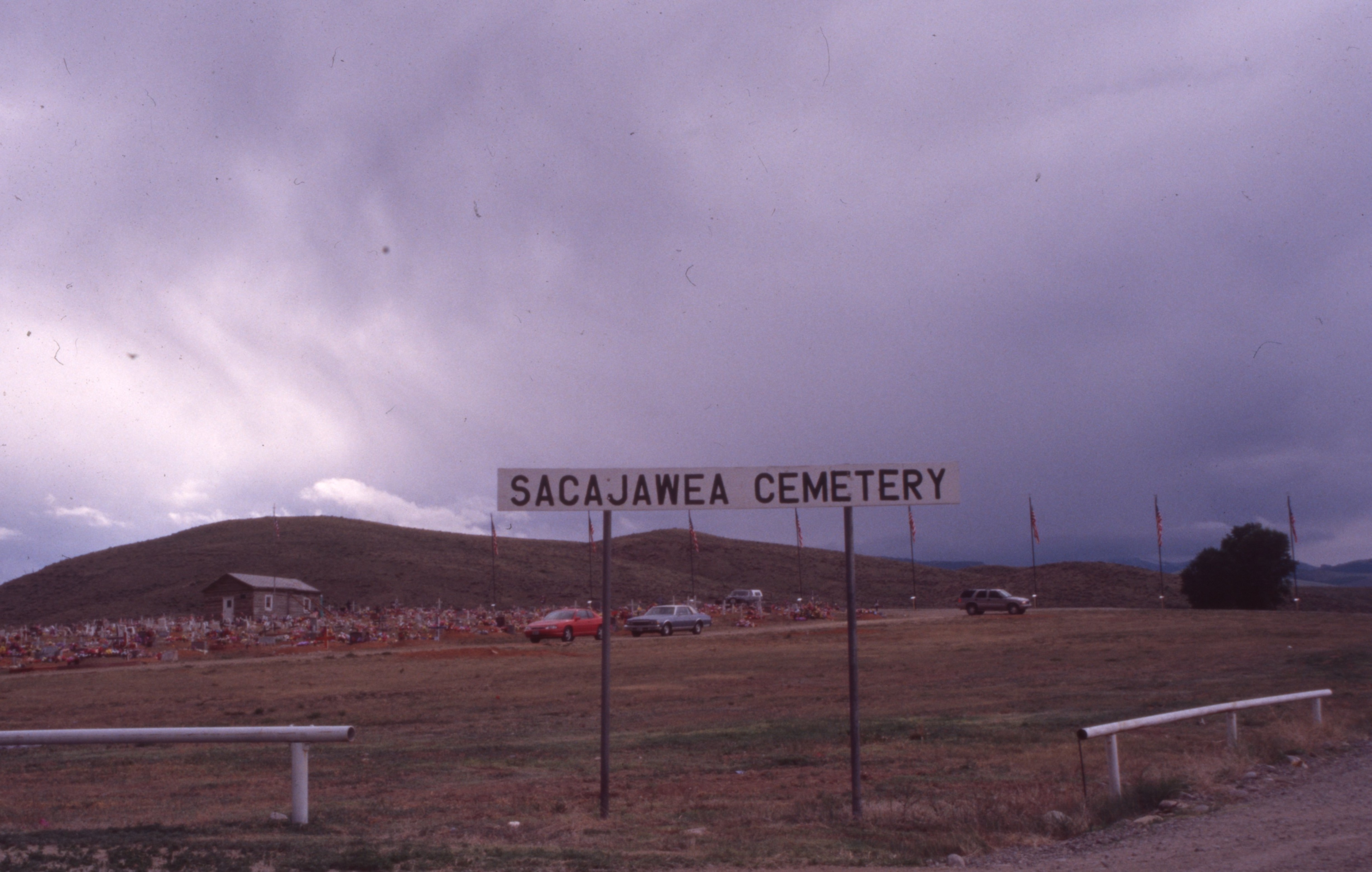
Rectangular white wood sign with black bold text positioned on two poles.
-
The Sacajawea cemetery is located in Fort Washakie, WY. The white signage marks its entrance. Her grave sits at the center of the cemetery, situated between two gravestones dedicated to her two sons. On her grave is a plaque erected in 1963 by the Wyoming State Organization of the National Society of the Daughters of the American Revolution. The standing map plaque is located within the cemetery among the gravestones.
Sources state that Sacajawea was buried at this location on April 9, 1884. Reverend John Roberts, officiator of her burial, aided in its identification. Though historical debate surrounding the location of Sacajawea's burial remains, this site is the most widely recognized as such.
-
Text
-
[Text on Plaque]
SACAJAWEA CEMETERY
This cemetery is named for the Shoshone
woman who became an Invaluable guide,
Interpreter and translator to the Lewis and
Clark Expedition.
Fifteen year old Sacajawea accompanied her husband, fur
trader Charbonneau, when he joined the Corps of Discovery in
1805. Throughout the 6,000 mile journey, her presence, with
their infant son Jean Baptiste, was visible proof to other
Indians that members of the Lewis and Clark expedition were
not a war party. Captain Clark wrote, "The wife of Shabano, our
interpreter, we find reconciles all the Indians, as to our friendly
intentions. A woman with a party of men is a token of peace."
The Eastern Shoshones believe Sacajawea is buried in
the Wind River Mountains west of here, and Charbonneau's
second wife, Sacajawea's sister, is buried in North Dakota.
The tall granite headstone east of this sign is
Sacajawea's burial marker.
1 Fort Mandan, March 17, 1803
French fur trader and interpreter,
Toussaint Charbonneau, his wife
Sacajawea, and their infant son
joined the Lewis and Clark Corps
of Discovery. The expedition
departed on April 7, 1805.
2 Camp Fortunate, August 15, 1805
Sacajawea recognized the Shoshone Chief
Cameahwait as her brother, whom she had
not seen since childhood. "She jumped up,
ran & embraced him, & threw her blanket
over him and cried profusely." Their reunion
was a pivotal moment in the expedition.
The Shoshones were now willing to trust
the strange white explorers and traded
them the horses they so desperately needed
to complete their journey.
3 Fort Clatsop
(now the town of Astoria, Georgia)
Sacajawea helped diffuse tensions between
the expedition and local tribes by trading her
beautiful beaded belt to a Chinook chief. She
later insisted on traveling with the men of
the expedition to view a beached whale.
(She recalled this sight the rest of her life,
and often told stories of "the big fish" and
the ocean waves that went on forever.)
4 July 3 - August 12, 1806
When Lewis and Clark split up to explore
different routes on the return trip, Sacajawea
and her family stayed with Captain Clark's
group. She guided them over Bozeman Pass,
to the Yellowstone River, and then on to
rendezvous with Captain Lewis. When they
met up with Lewis he was recovering from a
painful wound - he'd been accidentally shot
through the butt by one of his own men!
LEGEND
Lewis & Clark's Expedition
Clark's Return Route Variation
Sponsored by
THE SHOSHONE TRAIL
CULTURAL CENTER BOARD
Plaque courtesy of the Skaggs Foundation
-
[Text on Grave]
SACAJAWEA
DIED APRIL 9, 1884
A GUIDE WITH THE
LEWIS AND CLARK
EXPEDITION
1805 - 1806
IDENTIFIED 1907 BY
REV. J. ROBERTS
WHO OFFICIATED AT
HER BURIAL
ERECTED BY
THE WYOMING STATE ORGANIZATION
OF THE NATIONAL SOCIETY
OF THE DAUGHTERS
OF THE AMERICAN REVOLUTION
1963
-
[Text on Sign]
SACAJAWEA CEMETERY
-
Type
-
English
Display
-
English
Grave
-
English
Signage
-
Project Researcher
-
O'Neill, Iris
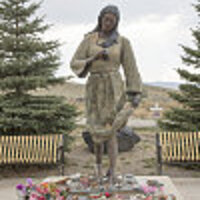 Sacajawea (1788-1812)
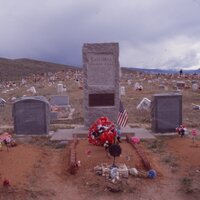 Sacajawea, Grave and Memorial, June 2001