-
Title
-
Biddy Mason, Memorial Structure and Plaque
-
Creator
-
de Bretteville, Sheila Levrant
-
Biographical Text
-
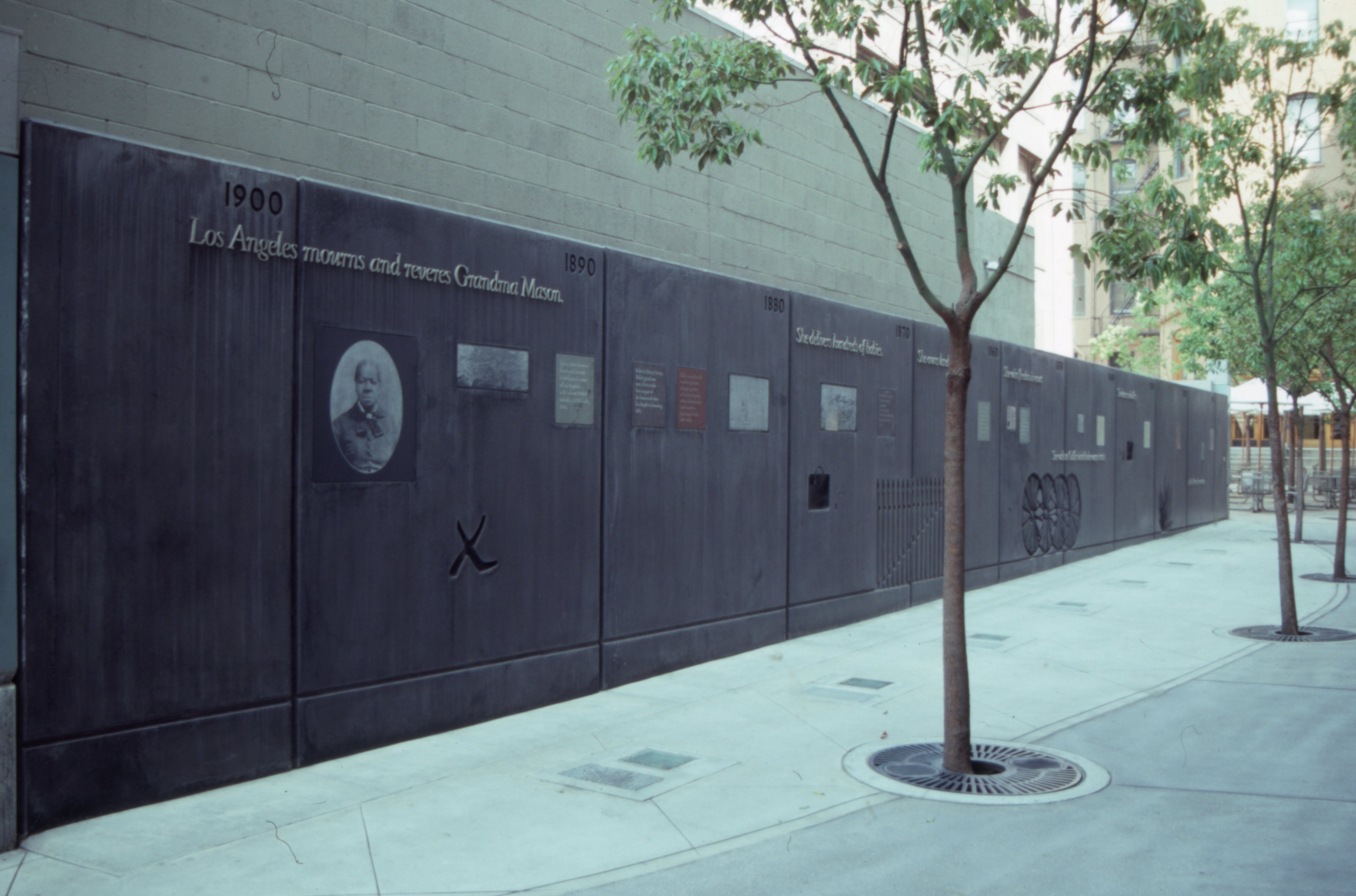
Stone structure exhibiting a timeline of Mason's life, titled “Biddy Mason: Time and Place.” Text, plaques, and impressions of objects relating to important aspects of her life are situated on the structure in chronological order beneath the particular decade that they correspond to. Sculpted by Sheila Levrant de Bretteville and completed in 1991.
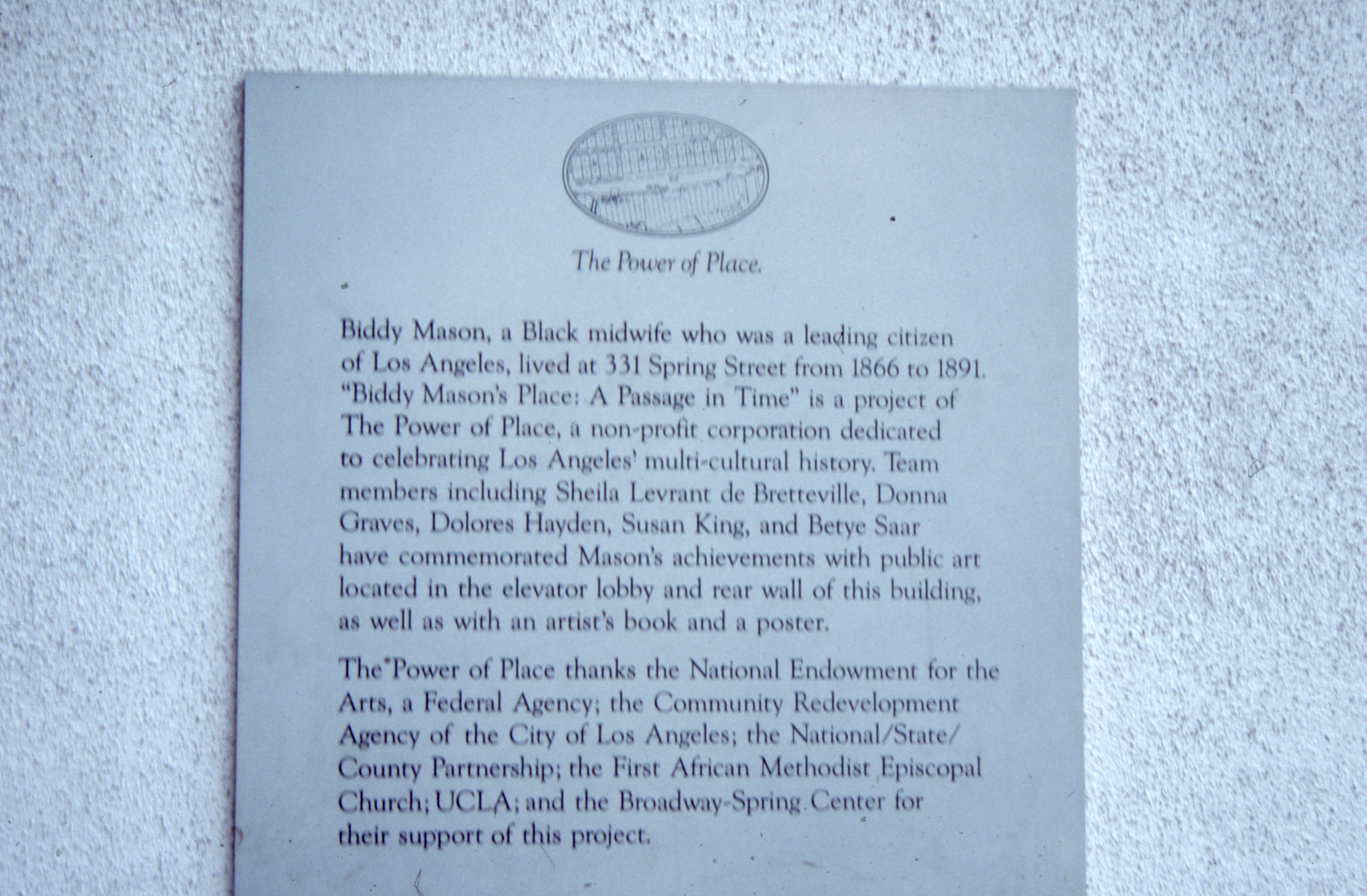
Stone Plaque describing the project, “Biddy Mason’s Place: A Passage in Time” and its contributors. Small oval emblem at the top.
The structure is part of the Biddy Mason Memorial Park, a site dedicated to the remembrance of Mason's resilient and inspiring life. The memorial was created by the nonprofit group, The Power of Place and resides on the exact location of the Los Angeles home she built in 1866. It is one of the first major examples of a Los Angeles public space acknowledging a historical figure of color. The structure continues to work as a reminder to the community of her accomplishments with the final text on the wall reading, “Los Angeles mourns and reveres Grandma Mason.”
-
Text
-
[Text on Plaque]
The Power of Place.
Biddy Mason, a Black midwife who was a leading citizen
of Los Angeles, lived at 331 Spring Street from 1866 to 1891.
“Biddy Mason’s Place: A Passage in Time” is a project of
The Power of Place, a non-profit corporation dedicated
to celebrating Los Angeles’ multi-cultural history. Team
Members including Sheila Levrant de Bretteville, Donna
Graves, Delores Hayden, Susan King, and Betye Saar
have commemorated Mason’s achievements with public art
located in the elevator lobby and rear wall of this building,
as well as with an artist’s book and a poster.
The *Power of Place thanks the National Endowment for the
Arts, a Federal Agency; the Community Redevelopment
Agency of the City of Los Angeles; the National/State/
County Partnership; the first African Methodist Episcopal
Church; UCLA; and the Broadway-Spring Center for
their support of this project.
-
[Text on Wall From Right to Left]
1810
Biddy Mason born a slave.
Forty-four settlers
from Mexico
establish the pueblo
of Los Angeles-
twenty-six have
African ancestors,
1781.
1820
The Plaza Church
is dedicated
in Los Angeles
now part of
the newly independent
Mexican nation
1821.
1830
She learns midwifery.
Eighteen year old Biddy
and her sister Hannah
become the property
of Robert Smith,
a plantation owner
in Logtown Mississippi,
1836.
1840
She walks to California behind a wagon train.
The United States
sends Lieutenant Ord
to survey Los Angeles
and he names this street
Calle Primavera
After his sweetheart,
1849.
1850
She wins freedom in court.
[Plaque Illegible]
Smith transports
slaves to California,
a free state where
Judge Hayes declares
Biddy Mason’s family
entitled to freedom
And free forever,
1856
1860
She owns land.
DEED.
William M. Ruffum
and
James F. Burns
To
Biddy Mason
Dated November 28th 1866
Filed for Record at request of
B. Masow
March 12th A.D. 186
At 20 min. past 3 P.M.
T.D. Mott Recorder
By J.W. Mott Deputy
From ten years’ wages
Biddy saves $250
to buy this homestead
Lots 3 and 8, Block 7
of the Ord survey,
a bit out of town, amid gardens and groves
1866.
1870
She delivers hundreds of babies.
Biddy calls a meeting
here in her home
to organize
the Los Angeles
First African Methodist
Episcopal Church,
1872.
1880
Robert and Henry Ownes,
Biddy’s grandsons,
start a livery stable
here on part of
her homestead when
Los Angeles is booming,
1885.
Biddy nurses the sick,
comforts prisoners,
and pays a grocery
at Fourth and Spring
to feed all the families
made homeless
by seasonal floods,
1880-1890.
1890
Spring Street between
Fourth and Seventh
is the financial center
of Los Angeles,
a city of over 50,000,
including 1,258 blacks,
1890.
1900
Los Angeles mourns and reveres Grandma Mason.
-
Date Created
-
1991
-
Type
-
English
Display
-
English
Signage
-
Project Researcher
-
O'Neill, Iris