-
Title
-
Blanche Ames Ames, House, Marker, and Display
-
Creator
-
Ames, Blanche Ames
-
Biographical Text
-
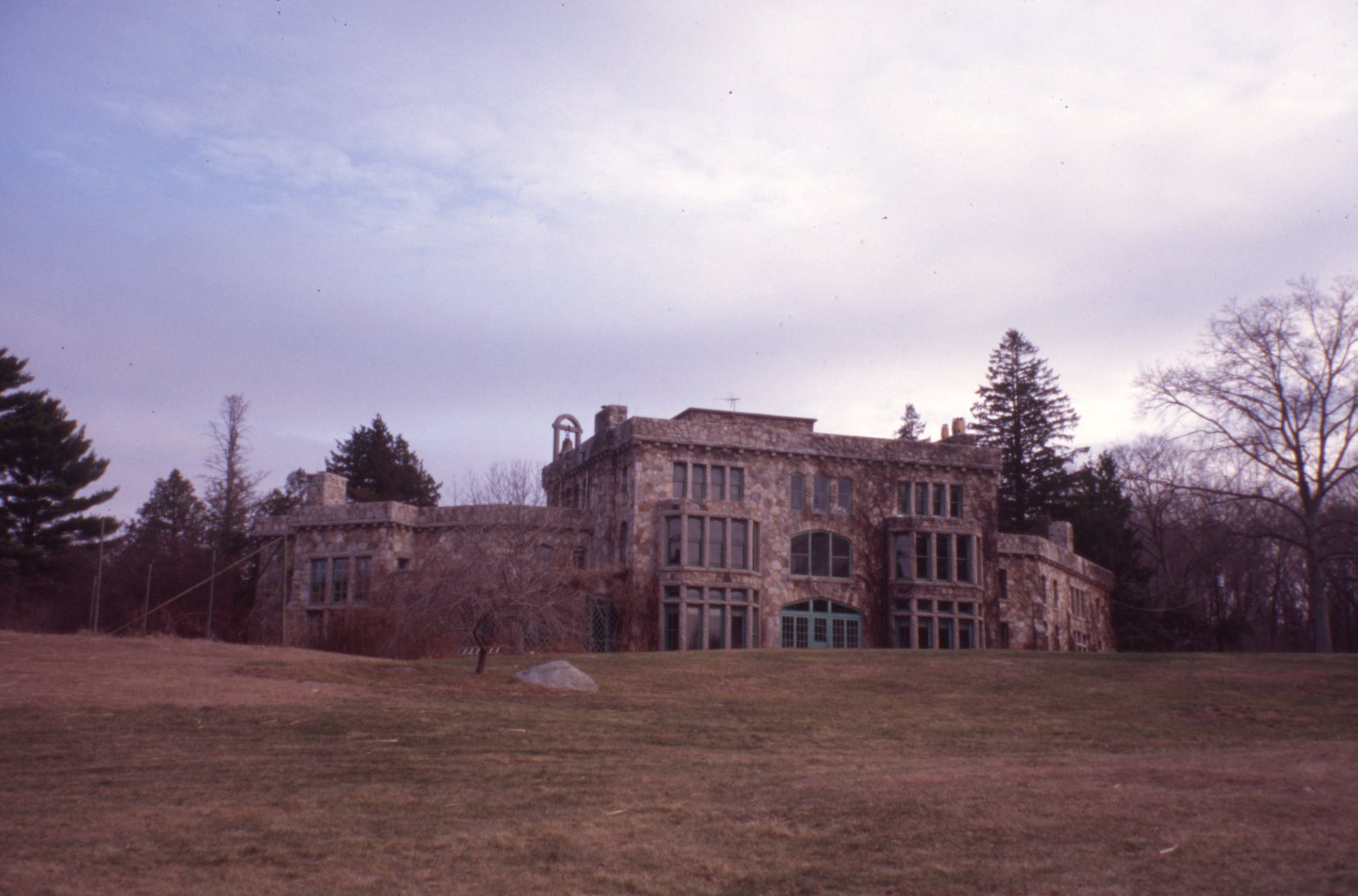
Borderland House is a 22,212 square foot, three story stone mansion built in 1910. The mansion was designed by Ames herself, who wanted to create a fireproof home and was dissatisfied by the work of other architects. It sits on a 1250 acre property.
Ames and her husband, Oakes Ames, lived in the mansion with their four children. On the third floor, Ames set up a studio. In this workshop she worked with her brother, Adelbert, to develop a scientific color system for mixing paints.
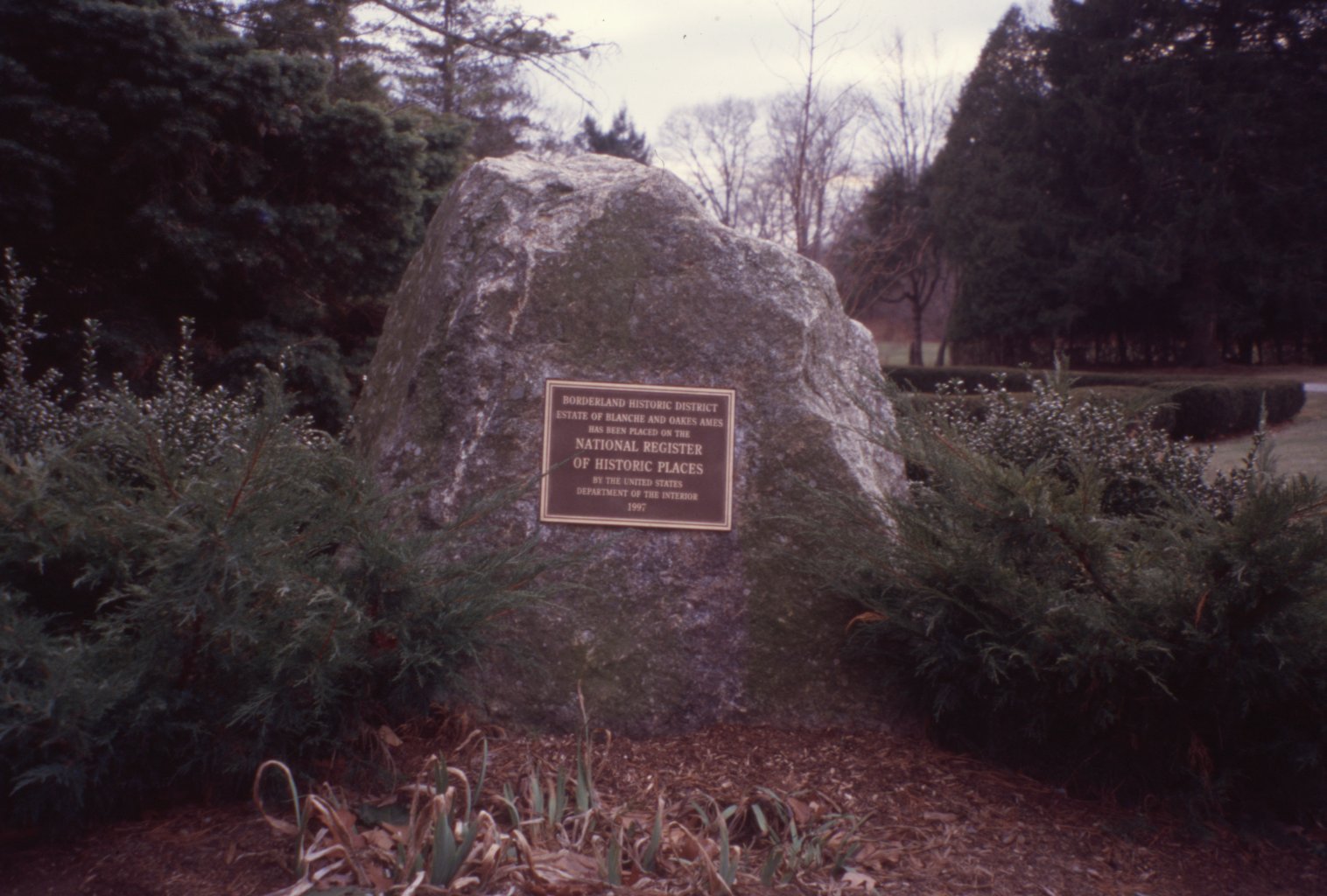
In 1971, following Ames’ death, the Commonwealth of Massachusetts acquired the property and it became a state park. The Ames family also donated most of the contents of the mansion to the state. In 1997, the Borderland Historic District was placed on the National Register of Historic Places by the US Department of the Interior. Today, the park is accessible to the public and has a variety of hiking and mountain biking trails, alongside ponds which can be used for fishing and non-motorized boating.
-
Text
-
BORDERLAND HISTORIC DISTRICT
ESTATE OF BLANCHE AND OAKES AMES
HAS BEEN PLACED ON THE
NATIONAL REGISTER OF HISTORIC PLACES
BY THE UNITED STATES
DEPARTMENT OF THE INTERIOR
1997
-
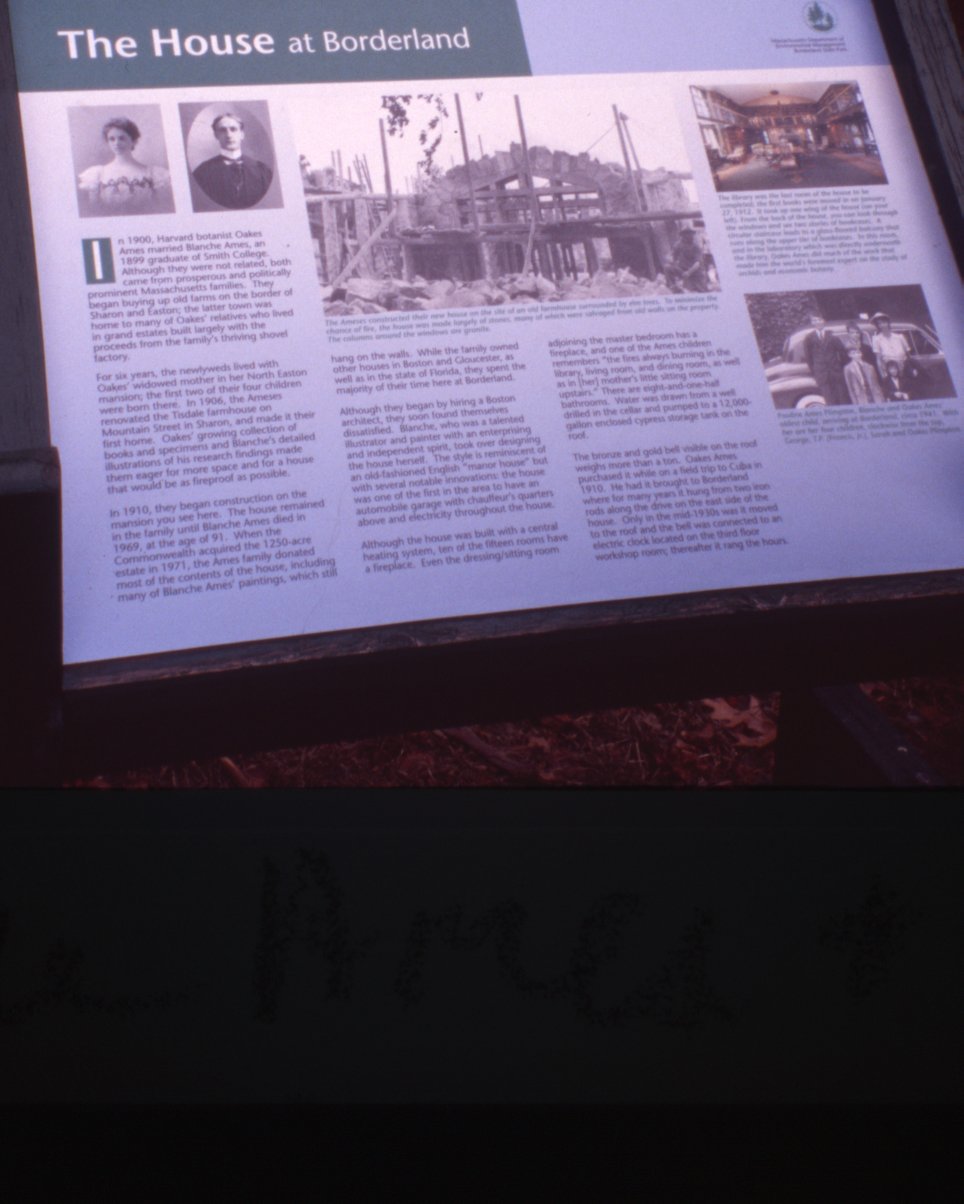
The House at Borderland
In 1900, Harvard botanist Oakes Ames married Blanche Ames, a 1899 graduate of Smith College. Although they were not related, both came from prosperous and politically prominent Massachusetts families. They began buying up old farms on the border of Sharon and Easton; the latter town was home to many of Oakes’ relatives who lived in grand estates built largely with proceeds from the family’s thriving shovel factory.
For six years, the newlyweds lived with Oakes’ widowed mother in her North Easton mansion; the first two of their four children were born there. In 1906, the Ameses renovated the Tisdale farmhouse on Mountain Street in Sharon, and made it their first home. Oakes’ growing collection of plants and specimens and Blanche’s detailed illustrations of his research findings made them eager for more space and for a house that would be as fireproof as possible.
In 1910, they began construction on the mansion you see here. The house remained in the family until Blanche Ames died in 1969. When the Commonwealth acquired the 1250-acre estate in 1971, the Ames family donated most of the contents of the house, including many of Blanche Ames’ paintings, which still hang on the walls. While the family owned other houses in Boston and Gloucester, as well as in the state of Florida, they spent the majority of their time here at Borderland.
Although they began by hiring a Boston architect, they soon found themselves dissatisfied. Blanche, who was a talented illustrator and painter with an enterprising and determined spirit, took over designing the house herself. The style is reminiscent of an old-fashioned English “manor house” but with several notable innovations: the house was one of the first in the area to have an automobile garage with chauffeur’s quarters above and electricity throughout the house.
Although the house was built with a central heating system, ten of the fifteen rooms had a fireplace. Even the dressing/sitting room adjoining the master bedroom has a fireplace, and one of the Ames children remembers, “the fires always burning in the library, living room, dining room, as well as in [her] mother’s little sitting room upstairs.” There are eight-and-one-half bathrooms. Water was drawn from a well drilled in the cellar and pumped to a 12,000-gallon enclosed cypress storage tank on the roof.
The bronze and gold bell on the roof weighs more than a ton. Oakes Ames purchased it while on a field trip to Cuba in 1910. He had it brought to Borderland, where for many years it hung from two iron rods. Only in the mid-1930s was it moved to the roof and the bell was connected to an electric clock located on the third floor workshop room, thereafter it rang the hours.
[Underneath image of the house’s construction]
The Ames constructed their new house on the site of an old farmhouse surrounded by [illegible] trees. To minimize the chance of fire, the house was made largely of stones, many of which were [illegible] [illegible] [illegible] walls on the property. The columns around the windows are granite.
[Underneath image of library]
The library was the last room of the house to be [rest of text illegible]
[Underneath image of Ames family]
[Text illegible]
-
Date Created
-
1910
-
Date Modified
-
1971
-
Type
-
English
Museum
-
English
Signage
-
Project Researcher
-
Bysterbusch, Hailey