-
Title
-
Hall, Marguerite Higgins
-
birthday
-
1920-09-03
-
Birthplace
-
Hong Kong, China
-
Death Date
-
1966-01-03
-
Occupation
-
War Correspondent
-
Journalist
-
Biographical Text
-
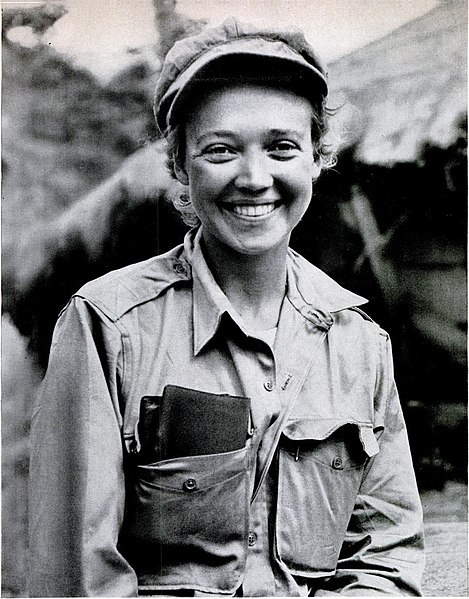
Marguerite Higgins Hall was one of the most decorated war correspondents of her time. Her father of Irish-American descent worked in Hong Kong when Marguerite was born. At just six months old Marguerite contracted malaria but managed a full recovery. At the age of three her family moved from Hong Kong, China to Oakland, California. After her father lost his job in the 1929 stock market crash, Marguerite attended the Anna Head School in Berkeley California, on a scholarship her mother secured by accepting a position as a French teacher at the school. In 1937 Higgins enrolled in the University of California Berkeley where she graduated with a bachelor's in French. She moved to New York City in 1941 with the intent to pursue journalism. After being denied a job at the New York Herald Tribune Higgins decided to remain in New York and attend Columbia University to earn a master's degree in journalism. Despite having to fight and plead her way into Columbia’s program, Higgins started to excel once at Columbia. She was motivated by her classmates which she viewed as competition. By the next year 1942, Higgins managed to secure the spot at the New York Herald Tribune that she was denied the year before. This position eventually led to her full-time position at the Tribune. Higgins was extremely eager to be a war correspondent and managed to persuade the management of the Herald to send her to Europe in 1944 to cover World War II. She was first stationed in London, then Paris, then finally in Germany where she witnessed the liberation of the Dachau concentration camp in 1945. Shortly after she covered the Nuremberg Trials and the Soviet Union’s blockade of Berlin. By 1947, Higgins became the Chief of the Tribune’s Berlin Bureau. In 1950, Higgins moved to Tokyo where she was once again named the Chief of the Tribune’s Tokyo Bureau. War broke out in Korea months later and Higgins was one of the first reporters to arrive. Higgins and her colleagues witnessed the Hangang Bridge Bombing and were trapped in the country. General Walton Walker insisted on Higgins’s removal for “safety concerns”, however, Higgins appealed to Walker’s superior General Douglas MacArthur who encouraged Higgins to stay. This was a major milestone for female war correspondents and Higgins made headlines back home in America. In 1951 Higgins was honored to receive the Pulitzer Prize for International Reporting which she shared with five other male correspondents. She was the first women to ever win the Pulitzer Prize for Foreign Correspondence. Higgins would stay with the Tribune to cover many other world events and leaders such as Francisco Franco and Nikita Khrushchev. In 1955, Higgins was the first American correspondent to enter the Soviet Union after Joseph Stalin's death. In 1963, she joined the Newsday and was assigned to cover Vietnam where she interviewed world figures and wrote her book Our Vietnam Nightmare. It was during Vietnam that Higgins seemed to develop a feud with her colleague David Halberstam. The two did not see eye to eye on the ideological plane and often had opposing interpretations of different events in Vietnam.
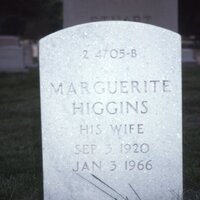
Marguerite Higgins met her first husband, Stanley Moore when she attended Berkley. Moore was a teacher's assistant in the philosophy department when the two first met. However, they did not form a connection in California, the two were acquainted in New York when Higgins worked for the Tribune and Moore was a Harvard professor. The two married in 1942 but soon after Moore was drafted into WWII. The relationship fell apart and the couple finalized the divorce in 1947. Higgins and Moore never had any children together. Higgins married her second husband, William Evans Hall in 1952. Hall was a U.S. Air Force major general that Higgins met while in Berlin. The couple settled down in Marin County and had their first child the following year. The child survived five days before passing away from the premature birth. Years later, in 1958 Higgins gave birth to her son, Lawrence Higgins Hall, and her daughter Linda Marguerite Hall in 1959. Higgins passed away from Leishmaniasis in 1966 after battling the disease for a few months after returning from Vietnam in November 1965.